Need a Virtual Number Right Now?
Skip the wait — rent an instant virtual number and start receiving SMS codes in seconds.
You enter your phone number, click Send Code, and wait for several minutes, but the verification code still does not appear. This is one of the most common problems when registering an account, logging in, recovering a password, or enabling two-factor authentication.
From the perspective of SMS Nova, which focuses on virtual phone number, temporary phone number, and receive SMS online, we find that many people often assume that an OTP not arriving means the phone number is faulty. In reality, the process of sending an SMS verification code involves many different systems.
If just one link in the chain encounters a problem, the code may arrive late, be blocked, or not be delivered. The important thing is to identify the correct cause. If the problem lies with the phone number, the solution will be different from a situation where the website is applying a rate limit or does not accept VoIP numbers. The article below analyzes the most common causes and the appropriate ways to handle them.
What Is an SMS Verification Code?
A verification code is commonly called an OTP – One-Time Password or verification code. It is a code generated for a specific session or action and can usually only be used once. OTPs commonly appear when users register an account, log in from a new device, reset a password, verify a phone number, or enable 2FA.
From the user’s perspective, the process is very simple:
Enter the number → request the code → receive the SMS → enter the OTP → complete verification
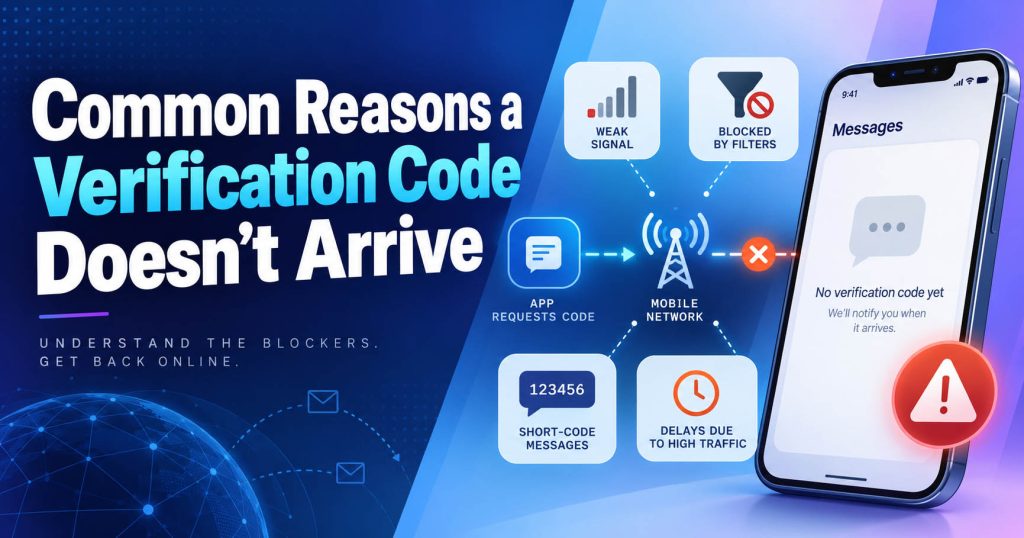
However, “Code Sent” does not mean that the message has definitely appeared on the device. This notification usually only indicates that the website has started the process of sending the code. After that, the SMS still has to pass through the gateway, carrier, and telecommunications network.
Therefore, it is necessary to distinguish between three statuses:
Sent means that the system has sent the request.
Delivered means that the message has been successfully delivered according to the network status.
Failed or Undelivered means that the message delivery process has failed.
This is the foundation for understanding why an OTP sometimes does not arrive even though the website has displayed a notification saying that “the code has been sent.”
Entering the Wrong Phone Number or Country Code
This is the simplest cause but also one of the most common. Just one incorrect digit can cause the OTP to be sent to a different number or rejected by the carrier. When using an international number, the country code is also particularly important.
For example, the website may automatically add the country code after you select the country. If the user enters the country code again, the number may become incorrectly formatted.
Another common mistake is keeping the leading 0 when the system requires an international format. Therefore, before considering more complicated issues such as SMS Gateway or carrier filtering, check again:
Is the phone number correct? Is the country code correct? Is the number format compatible with the input field?
For SMS Nova users, we always recommend copying the number directly from the dashboard instead of entering it manually to minimize errors.
The Phone Number or Device Cannot Receive SMS
Not every phone number is capable of receiving every type of SMS. Some landlines do not support messaging. Some VoIP Numbers may also have limited ability to receive short codes or A2P SMS. If you are using a physical SIM, the device must also be connected to the mobile network.
The phone may not receive an OTP if it is:
Powered off, outside the coverage area, has no signal, or is experiencing a network registration error.
Users sometimes confuse Internet connectivity with mobile network connectivity. A phone may still be able to access the Internet via Wi-Fi but not have a sufficiently good cellular connection to receive SMS.
If you are using a physical SIM and are not receiving the code, check whether you can receive normal SMS messages from another number.
If even personal messages do not arrive, the problem is more likely to be with the device or carrier, rather than the website sending the OTP.
Roaming Makes SMS More Difficult to Deliver
When using a SIM abroad, SMS messages may have to pass through multiple roaming networks. A domestic OTP usually has a simpler route. When a user is roaming, the message may need to be processed through the home network, roaming partner, and carrier in the current country.
This increases the number of intermediary layers and may result in delay or delivery failure. If you only experience the problem while traveling or using a SIM outside the country where it was issued, roaming is a factor that should be considered.
The Message Has Arrived but Has Been Filtered
There is a fairly common situation where the OTP has actually arrived, but the user cannot see it.
Today’s smartphones often have features such as:
Spam filtering, Unknown Senders, Blocked Messages, or automatic SMS filtering mechanisms.
Some third-party messaging apps also automatically categorize transactional SMS messages.
Therefore, before pressing Resend Code, check these folders as well.
If the sender or short code has previously been blocked, the SMS may also not appear in the main inbox.
This is one of the simplest checking steps, but it is often overlooked.
Carrier Filtering Blocks SMS Verification Messages
One of the most important technical reasons why a code does not arrive is carrier filtering. Carriers process a large volume of A2P SMS every day. To limit spam, phishing, SMS fraud, and non-compliant traffic, they use various automated systems to evaluate messages.
The factors that may be considered include:
Sender reputation, volume, frequency, content patterns, and traffic history.
If a sender is considered risky, the message may be held or blocked.
It is important to understand that even a legitimate SMS can still be affected by filtering.
From the user’s perspective, this is very difficult to identify because the phone may still receive normal SMS messages from other sources.
If only one particular platform cannot send an OTP while all other services are still working normally, the sender or route used by that platform may be the cause.
Short Code Is Blocked or Not Supported
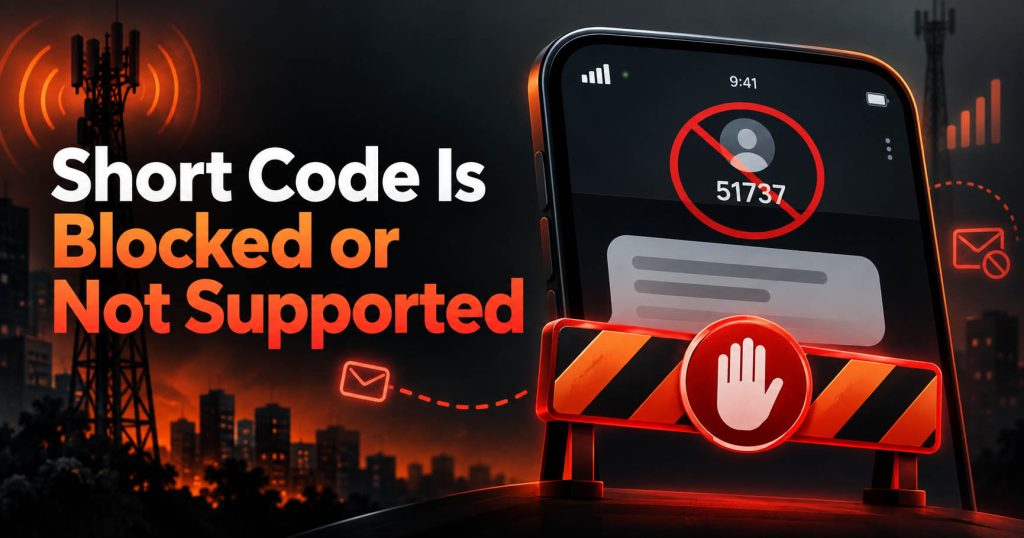
Many websites do not send OTPs from a regular long phone number but instead use a short code. A short code is a short number designed for automated messaging, commonly used for OTPs, notifications, and interactive programs.
However, not every carrier, country, or number type supports every short code. A user may be able to receive SMS from regular numbers but not receive an OTP from a short code.
This is particularly worth noting with some VoIP Numbers or international routes. If multiple services using short codes are unable to deliver the code, users should check with their carrier or use another verification method if the platform supports one.
Too Many OTP Requests and Being Rate Limited
One of the most common mistakes is repeatedly pressing Resend Code. When the OTP has not appeared, users often assume that sending more requests will increase the chances of receiving the code. In reality, websites commonly use rate limits to limit the number of OTPs sent within a certain period.
The purpose is to prevent:
Spam, brute force, bots, and SMS pumping. If the system detects too many requests from the same account, phone number, or IP, it may temporarily stop sending codes.
In this case, you may see messages such as:
Too many attempts, Try again later, or Too many verification requests.
In this situation, continuing to press Resend does not help. On the contrary, it may make the waiting period longer. At SMS Nova, we recommend that users always follow the website’s timer instead of repeatedly requesting OTPs.
The Anti-Fraud System Detects Unusual Activity
Websites do not only evaluate the phone number. Modern anti-fraud systems can assess many other signals, such as IP, country, device, cookies, login frequency, account behavior, and verification history.
If a user logs in from an unusual location, frequently changes devices, or makes too many requests within a short period, the website may proactively refuse to send the OTP. A VPN can also become a signal in some systems, especially if the IP address changes continuously between countries.
This does not mean that a VPN will always cause OTP verification to fail. Each website has its own policies. However, if the system displays “Try again later” or an unusual activity warning, the issue may lie with risk control rather than the phone number.
Need a Virtual Number Right Now?
Skip the wait — rent an instant virtual number and start receiving SMS codes in seconds.
The SMS Provider or Carrier Is Experiencing an Issue
Even when both the phone number and website are working normally, the intermediate SMS system may still experience problems.
An OTP may pass through:
Website → SMS API → Gateway → Aggregator → Carrier → Device
Any component can experience downtime, route interruption, or congestion. During peak hours, the message queue can also increase rapidly. If the system generates more SMS messages than it can process, the messages have to be queued. Some will arrive late, while others may fail if the queue exceeds its limit.
This is why sometimes a user tries again after a few minutes and the OTP starts working normally without anything being changed.
The VoIP Number or Virtual Phone Number Is Not Supported by the Platform
This is a very important issue for users of virtual phone number.
Not every website accepts:
VoIP Number, Virtual Phone Number, Temporary Phone Number, or Disposable Phone Number.
Some platforms actively restrict these types of numbers to reduce:
Fake accounts, spam, automated registration, or abuse.
In this case, the number may still be working completely normally and receiving SMS from many other sources, but the specific website still does not send the OTP.
This is not delivery failure in the technical sense, but rather a compatibility or policy restriction.
How Can You Recognize It?
If the website displays:
This phone number cannot be used, Unsupported phone number, or a similar message, the platform most likely does not accept that type of number.
In that case, repeatedly pressing Resend Code will not solve the problem.
The Phone Number Has Been Used Too Many Times
Another possible cause is the number’s usage history. Many platforms limit the number of accounts that can be verified using the same phone number. If a number has been used too many times, the website may refuse to send the OTP or require a different number.
This can happen especially with shared numbers or public SMS inboxes. Therefore, when choosing a temporary number, it is not only the ability to receive SMS that matters; the number’s compatibility with the service should also be considered.
The Sender ID or SMS Route Is Not Suitable
In many markets, A2P SMS must comply with specific regulations regarding Sender ID, message templates, or brand registration. If the sender is not properly registered or the route is not compatible with the destination carrier, the SMS may be blocked.
This is a factor that end users can hardly fix themselves. If all settings on the user’s side are correct but the code still does not arrive, the issue may lie with the website’s sender or route.
Route Quality Also Matters
Not all SMS routes are the same. Some routes go almost directly to the carrier. Others pass through multiple aggregators. The more intermediary layers there are, the higher the possibility of filtering, delay, or failure.
What Should You Do When the Verification Code Is Not Delivered?
Instead of trying random solutions, we recommend checking in sequence.
First, confirm the phone number and country code.
Next, if you are using a physical SIM, check the signal and try receiving a normal SMS.
Then, check Spam, Unknown Senders, and Blocked Messages.
If you have already requested multiple OTPs, stop and wait according to the website’s timer. If the code still does not arrive, check whether the platform provides other methods such as email, voice call, authenticator app, passkey, or backup code.
A useful rule is:
If you cannot receive any SMS at all → check the device and carrier.
If only one website cannot send the OTP → check the website, sender, route, or number policy.
What Should You Do If You Do Not Receive a Verification Code on SMS Nova?
If you are using SMS Nova, start by checking the correct country and service.
The process should be:
Select country → select service → get a number → enter the number → request OTP → monitor SMS
You should not randomly select a number and assume that it will work with every website.
Check the Number Status
Make sure the number is still within the active usage session and that the dashboard is still active. If the number has expired, you may no longer receive new messages.
Do Not Send Too Many OTP Requests
Repeatedly clicking Resend can trigger the website’s own rate limit. If you have just requested a code, wait for a reasonable amount of time.
Check Compatibility
If the website reports that the number is not supported, this is usually a restriction on the platform’s side. In that case, changing the route or choosing a more suitable number type may be necessary, but you should not keep changing numbers after waiting only a few seconds.
How Can You Tell Whether the Problem Is With the Number or the Website?
You can use some simple indicators. If the number does not receive SMS from any source, the problem is likely with the carrier, route, or the number itself. If the number still receives other SMS messages but only one website does not send the code, the problem is more likely to be with the sender or the website.
If the website reports:
Too many attempts → rate limit.
This phone number cannot be used → restriction.
Code sent but the SMS does not arrive → it could be a delay, filtering, or route failure.
Correctly distinguishing these cases helps avoid wasting time repeatedly trying the same solution.
Frequently Asked Questions About Verification Codes Not Being Delivered
Why Is the Phone Number Correct but the OTP Still Not Received?
Having the correct number is only one condition. The carrier, route, filtering, short code, and the website’s policies can still prevent the OTP from arriving.
Should You Click Resend Code Multiple Times?
No. Doing so can trigger a rate limit and cause the system to temporarily stop sending codes.
Can a Blocked Short Code Prevent the OTP from Arriving?
It can. Some carriers or number types have limitations on short-code messaging.
Can a Virtual Phone Number Receive OTPs?
It can if the number supports SMS, the route is compatible, and the website accepts that type of number.
Why Does a VoIP Number Not Receive the Verification Code?
Some websites deliberately do not support VoIP Numbers for anti-spam or abuse-prevention reasons.
Does a VPN Affect OTP Delivery?
It can, depending on the website’s anti-fraud system. An unusual change in IP address or location can sometimes increase the risk score.
Does Not Receiving an OTP Mean the Message Has Failed?
Not necessarily. The SMS may still be delayed or pending.
When Should You Contact the Carrier?
If multiple websites and multiple different short codes are all unable to send SMS to your SIM number, the carrier is one of the places you should check.
When Should You Try a Different Number?
When there is clear evidence that the current number is incompatible or the website rejects that type of number, rather than simply because the OTP is delayed by a few seconds.
Reference sources:
https://support.google.com/accounts/answer/185834
https://www.twilio.com/docs/messaging/guides/debugging-tools
https://www.infobip.com/docs/sms/troubleshooting
Need a Virtual Number Right Now?
Skip the wait — rent an instant virtual number and start receiving SMS codes in seconds.

 Apple
Apple  Telegram