Need a Virtual Number Right Now?
Skip the wait — rent an instant virtual number and start receiving SMS codes in seconds.
How to Protect Your Personal Phone Number Online Safely and Effectively · 2:02
Transcript
Phone numbers today are no longer used only as a tool for making calls or receiving SMS. They are also used to register accounts, receive OTPs, enable two-factor authentication, recover passwords, link social media accounts, verify identities, and use many other online services. Therefore, protecting your personal phone number has become an important part of protecting privacy on the Internet. When the same phone number is used across too many websites, applications, and platforms, that number may appear in many different databases. Over time, this increases the risk of receiving spam, smishing, marketing calls, phishing, or having the number linked to other personal data. Therefore, the most effective way to protect your phone number is not only to block spam calls, but more importantly, to control which services are allowed to know and store your number. Why Should You Protect Your Personal Phone Number Online? One of the most important reasons is that a phone number is gradually becoming a digital identifier. On many platforms, a phone number is used to create an account, log in, receive SMS verification, verify an identity, or recover a password. This makes the phone number a data point that can appear across multiple different accounts. If the same number is used for banking, social media, shopping websites, marketplaces, messaging applications, and marketing programs, it can become a common point between multiple user profiles. A phone number itself does not contain all personal information, but when combined with a name, email, address, or professional data, it can help form a more detailed profile. Another issue is that phone numbers are often more difficult to change than passwords or secondary email addresses. If a password is exposed, users can change it within a few minutes. However, if a phone number has already been linked to a bank, primary email, 2FA, family members, and customers, changing the number can cause a great deal of inconvenience.
Phone numbers today are no longer used only as a tool for making calls or receiving SMS. They are also used to register accounts, receive OTPs, enable two-factor authentication, recover passwords, link social media accounts, verify identities, and use many other online services. Therefore, protecting your personal phone number has become an important part of protecting privacy on the Internet.
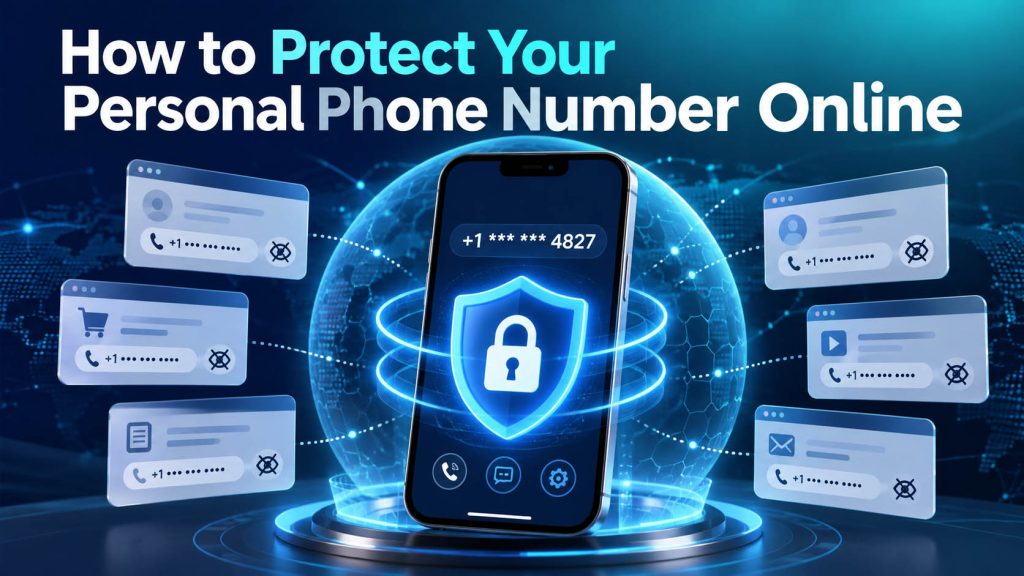
When the same phone number is used across too many websites, applications, and platforms, that number may appear in many different databases. Over time, this increases the risk of receiving spam, smishing, marketing calls, phishing, or having the number linked to other personal data. Therefore, the most effective way to protect your phone number is not only to block spam calls, but more importantly, to control which services are allowed to know and store your number.
Why Should You Protect Your Personal Phone Number Online?
One of the most important reasons is that a phone number is gradually becoming a digital identifier. On many platforms, a phone number is used to create an account, log in, receive SMS verification, verify an identity, or recover a password. This makes the phone number a data point that can appear across multiple different accounts.
If the same number is used for banking, social media, shopping websites, marketplaces, messaging applications, and marketing programs, it can become a common point between multiple user profiles. A phone number itself does not contain all personal information, but when combined with a name, email, address, or professional data, it can help form a more detailed profile.
Another issue is that phone numbers are often more difficult to change than passwords or secondary email addresses. If a password is exposed, users can change it within a few minutes. However, if a phone number has already been linked to a bank, primary email, 2FA, family members, and customers, changing the number can cause a great deal of inconvenience. Therefore, prevention is always better than trying to deal with the problem after the number has been widely exposed.
How Are Personal Phone Numbers Commonly Exposed on the Internet?
There are many ways that a personal phone number online can appear in more places than users realize.
One of the most common sources is social media. Users may have previously included their phone number in their bio, contact information, or an old post. Some people also publicly display their number in buying and selling groups, job postings, or business profiles without realizing that this information may remain available for a very long time.
Online forms are another common source of exposure. A website may request a phone number when registering an account, participating in a giveaway, receiving a coupon, registering for an event, or trying a service. If users use their primary number for every form, that number will gradually appear in many different databases.
Marketplaces are also a source of risk. Many sellers or people conducting online transactions publicly display their phone number so buyers can contact them. This is convenient, but at the same time, it turns the phone number into public-facing data that may be collected by search engines or automated systems.
In addition, some applications request access to contacts to find friends or synchronize contacts. If users grant permission without carefully checking it, a large amount of contact data may be uploaded to the application’s system.
Finally, data breaches and data brokers are also two important factors. A website that previously stored your phone number may experience a security incident, while data brokers may aggregate numbers from public records, marketing databases, or various other commercial sources.
10 Effective Ways to Protect Your Personal Phone Number
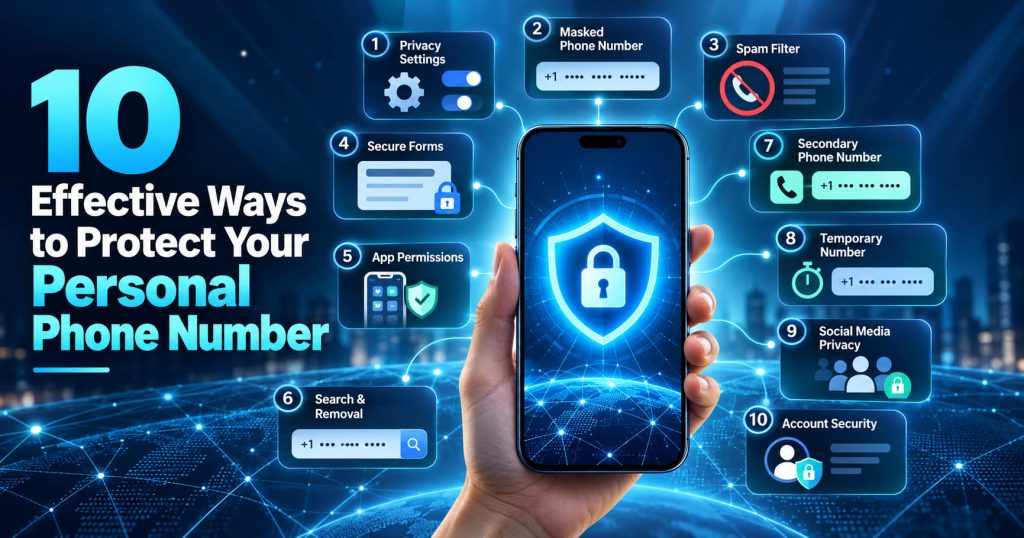
Do Not Provide Your Phone Number Unless It Is Truly Necessary
This is the most important principle. Before entering your number on a website, ask yourself whether the platform actually needs your phone number to provide its service. If the phone number field is optional, skipping it is often the safer choice.
Many people have a habit of filling in every field in a form simply because the fields appear on the screen. However, under the principle of data minimization, you should only provide the data necessary for the purpose you are carrying out. Every website that does not have your primary number is one less place that can store, share, or expose that data.
Do Not Publicly Display Your Phone Number on Social Media
Social media platforms often allow users to hide their phone number from their public profile. Check the contact information section and limit who can see your number.
In addition to your profile, you should also review old posts. If you previously posted your number in a sales post, job posting, or forum, consider editing or deleting it when the information is no longer necessary.
In particular, a phone number that has previously been indexed by search engines may continue to appear even after the user has completely forgotten about the old post.
Turn Off the Feature That Allows Accounts to Be Found by Phone Number
Some social media platforms allow other people to find your account by entering your phone number.
If privacy is a priority, check settings such as “Who can find me by phone number?” or “Phone number discoverability” and limit this feature if the platform supports it.
Hiding the number from your profile while still allowing people to search for you by phone number may make it easier to link your identity to the phone number.
Limit Apps’ Access to Your Contacts
Not every application needs access to your contacts. If an app requests permission to read your contacts to suggest friends but you do not need that feature, refusing the permission is completely reasonable. You can also go to your phone’s privacy settings to check which applications currently have access to your contacts and disable permissions that are no longer necessary. This is a small but very useful step for reducing the amount of contact data shared with third parties.
Use a Secondary Number for Work and Public Activities
If you frequently sell products online, freelance, post advertisements, or communicate with customers, using a secondary number can help separate your personal life from public-facing activities.
A number used for work can be made more widely available without directly exposing the primary number linked to your bank, email, or family members. This is also a way to reduce spam and unwanted calls to your personal number.
Use a Temporary Phone Number for Short-Term Activities
In situations where you only need a number to receive an OTP or complete a short-term registration process, a temporary phone number can be a solution worth considering if the platform allows it.
For example, if you only need to try a tool, participate in a promotional program, or test an SMS process, using your primary number may not be necessary.
However, a temporary number should not be used for important accounts such as banking, primary email, PayPal, government services, or accounts that require long-term account recovery.
The value of a temporary number lies in reducing the exposure of your primary number, not in completely replacing your personal phone number.
Do Not Use One Phone Number for Every Account
A good strategy is to separate numbers according to their level of importance. Your primary phone number should be reserved for banking, primary email, family, 2FA, and account recovery. A secondary number can be used for work, marketplaces, or public communications. A temporary or virtual number can be used for short-term signups, testing, and activities that do not require maintaining the number long-term. This separation helps reduce the possibility that a single phone number will appear in dozens of different databases.
Search for Your Phone Number on Google
A simple way to check your level of exposure is to enter your own phone number into a search engine, preferably placing it in quotation marks. You can try different formats, such as the version with the country code and the local-number format.
In addition to the phone number, you should also search for your name together with the number. This can help identify old profiles, forums, posts, or directories that are publicly displaying your information.
Request Removal of Your Number From Websites or Data Brokers
If you find your phone number on a people-search site, public directory, or old website, check whether the platform provides a removal or opt-out mechanism. Removing data from the Internet is not always easy, but every source that is removed helps reduce your level of exposure.
For accounts that are no longer in use, you should also log in and remove your phone number if possible instead of allowing the data to remain indefinitely.
Check Regularly
Protecting your phone number is not something you only do once. Data may be crawled again, synchronized to new sources, or appear in a database that did not previously exist. Therefore, you should occasionally check search results, privacy settings, and old accounts. A regular checking habit can help detect exposure early, before the number becomes too widely distributed.
How to Check Whether Your Phone Number Has Been Exposed
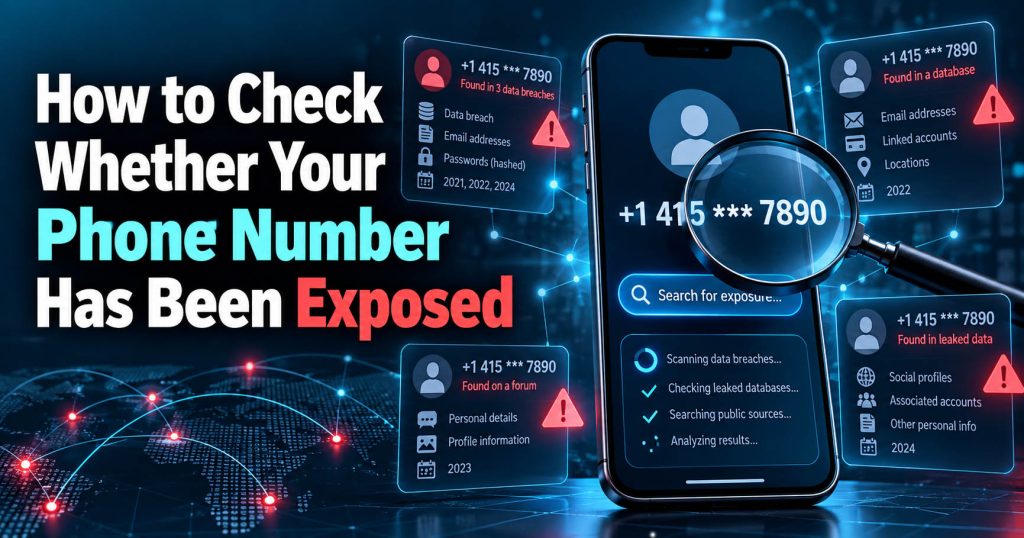
If you want to know where your phone number is appearing, the first step is to search for the number using a search engine. Try both the international and local formats, and place the number in quotation marks to find more accurate results.
Next, check the social media platforms you use. Review your profile, contact information, old posts, and privacy settings. Many people discover that their phone number is still publicly displayed on a platform they used many years ago.
Old websites such as forums, marketplaces, online CVs, business listings, or ecommerce accounts should also be reviewed. If you no longer use them, remove the number or close the account when possible.
People-search sites are also worth paying attention to. In some countries, these websites may display phone numbers, addresses, and related information. If you find your own profile, check the opt-out process.
In addition, signs such as a sudden increase in spam, receiving many marketing calls, or phishing SMS containing information directly related to your name or the services you use may indicate that your number has appeared in a new data source.
What Should You Do If Your Personal Phone Number Has Been Exposed?
If you discover that your number has been publicly exposed, you do not necessarily need to change it immediately. Changing your number can create many problems with banking, 2FA, email, and long-term contacts.
The first step should be to reduce exposure. Remove your number from public profiles, old posts, directories, and marketplaces that you no longer use. If your number appears in a data broker database, look for an opt-out or removal request.
Next, enable spam filtering on your phone. On iPhone, you can use Filter Unknown Senders, while Android and Google Messages usually have their own spam protection features.
Need a Virtual Number Right Now?
Skip the wait — rent an instant virtual number and start receiving SMS codes in seconds.
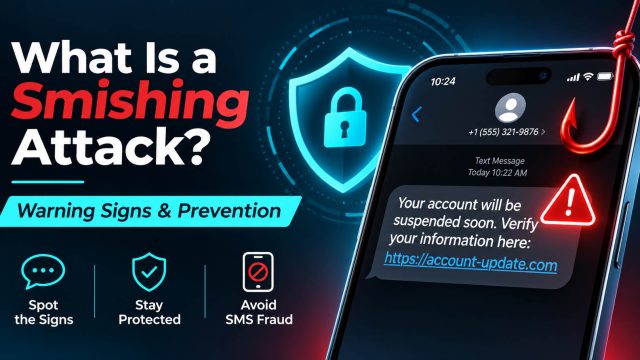
Users should also be particularly cautious about smishing. If you receive an SMS asking you to click a link to verify an account, make a payment, or log in, access the official website or application directly instead of using the link in the message.
If you are concerned that your number has been exposed along with other information, you should strengthen security for important accounts. Where possible, use an authenticator app or security key instead of relying entirely on SMS 2FA.
Can a Temporary Phone Number Help Protect Your Personal Number?
Yes, if it is used for the right purposes. A temporary phone number can create a layer of separation between your primary number and websites that only need a number for a short period of time. Instead of using your personal number on dozens of platforms, you can keep your primary number for important accounts and use a temporary number for activities with a lower level of risk.
For example, a testing website, coupon program, or service that only requires a one-time OTP may not necessarily need to know the number you use for banking and your primary email.
However, keep in mind that a temporary number may expire or be recycled. If an account needs to receive a code six months or one year later, losing control of the number can create problems.
Therefore, a temporary number is more suitable for short-term verification, not long-term recovery.
What Is the Difference Between a Virtual Phone Number and a Temporary Phone Number?
A virtual phone number is a broader concept. A virtual number can be used for a short period or long-term and does not necessarily have to be linked to a traditional physical SIM.
Meanwhile, a temporary phone number emphasizes the usage period. It is usually used for a specific task or period of time.
A disposable phone number is even more short-term, usually used once and then discarded. A second phone number, on the other hand, is more suitable for people who want to maintain two numbers long-term, such as one personal number and one work number.
When the goal is to protect privacy, what matters is not the name of the number type, but your control over the number, its usage period, and the level of privacy provided by the inbox.
SMS Nova Expert Advice: Categorize Phone Numbers by Level of Importance
From SMS Nova’s perspective, users should not use a single number for every online activity.
A primary phone number should be treated as high-value data and only used for services that truly require it, such as banking, primary email, family, financial accounts, or long-term recovery.
A second number can be used for work, marketplaces, or activities that are more public in nature but are used regularly.
For short-term activities, users may consider using a virtual phone number or temporary phone number from SMS Nova to reduce the number of websites that store their real phone number. This approach does not create complete anonymity, but it can help reduce exposure and increase control over personal data.
A very important principle is not to use a temporary number for accounts that require long-term access. If a service may require account recovery in the future, prioritize a number that you can control for many years.
In addition, the ability to receive OTPs always depends on the policies of each platform, the country, and the number type. Therefore, you should not expect a virtual number to work with every service.
Common Mistakes When Protecting Your Phone Number
A common mistake is publicly displaying a phone number on the Internet and assuming that a spam blocker will solve every problem. In reality, a spam blocker only handles messages or calls that have already arrived; it does not reduce the number of databases storing your number.
Another mistake is using your primary number for every online form. This gradually causes the phone number to become a common identifier across multiple accounts.
On the other hand, some people use a temporary number even for important accounts. This can also create risks because if the number expires, account recovery may become difficult.
Users should also avoid clicking an unsubscribe link in a suspicious SMS. For legitimate marketing, unsubscribing may be safe, but with scam messages, interacting with the message may confirm that the number is active.
Finally, users should not assume that using a virtual number means complete anonymity. Websites can still collect IP addresses, cookies, email addresses, browser fingerprints, and many other types of data.
10-Minute Checklist to Protect Your Personal Phone Number
If you want to get started immediately, you can follow a short process that includes searching for your number on Google, checking your social media profiles, disabling phone-number discoverability, removing your number from old accounts, and reviewing the contacts permissions granted to applications.
After that, enable spam filtering, avoid entering your number into fields that are not required, and separate your personal number from the number used for work or public-facing activities.
If you frequently need to sign up for short-term services, consider using a secondary or temporary number instead of continuously sharing your primary number. Even these simple changes can significantly reduce your phone number’s level of exposure over the long term.
Frequently Asked Questions
Should I Publicly Display My Phone Number on Social Media?
It is not recommended unless there is a specific reason. If you need to make a number public for work, consider using a secondary number instead of your personal number.
How Can I Find Out Where My Phone Number Is Appearing?
You can search for your number on Google and check social media, forums, directories, and people-search sites. Try multiple number formats.
Can Data Brokers Collect Phone Numbers?
Yes. Data brokers commonly aggregate data from public records, marketing sources, and various other commercial sources.
Can I Completely Remove My Phone Number From the Internet?
Not always, but users can significantly reduce public exposure by deleting old profiles and requesting opt-outs from sources that support them.
Is a Virtual Phone Number Safe?
The level of safety depends on the provider, your control over the number, and whether the inbox is public or private. Public numbers should not be used for sensitive data.
Does a Temporary Phone Number Protect My Real Number?
It can help reduce the number of websites that know your primary number, but it does not provide complete anonymity.
Should I Use a Temporary Number for Banking?
It is not recommended. Bank accounts require a stable number to receive OTPs and support long-term account recovery.
If My Phone Number Has Been Exposed, Do I Need to Change It?
Not necessarily. First, reduce exposure, remove publicly available data, and strengthen account security. Changing the number should only be considered when the risk is serious or cannot be controlled.
Is an Authenticator App Better Than SMS 2FA?
In many cases, an authenticator app can reduce dependence on a phone number and limit certain risks related to SIMs.
Is a Public SMS Inbox Suitable for Important OTPs?
No. If the inbox is public, other people may be able to read the SMS messages. This type of number should not be used for sensitive accounts.
Reference sources:
https://www.staysafeonline.org/fr/articles/comment-votre-numero-de-telephone-est-expose-fuites-de-numero-de-telephone
https://www.microsoft.com/en-us/edge/learning-center/how-to-protect-your-phone-number-online
https://consumer.ftc.gov/articles/what-know-about-people-search-sites-sell-your-information
https://consumer.ftc.gov/consumer-alerts/2023/12/how-are-robocallers-getting-your-phone-number
https://support.apple.com/vi-vn/125068
https://proton.me/blog/what-people-finder-sites-know-about-you
Need a Virtual Number Right Now?
Skip the wait — rent an instant virtual number and start receiving SMS codes in seconds.

 Apple
 Telegram