Need a Virtual Number Right Now?
Skip the wait — rent an instant virtual number and start receiving SMS codes in seconds.
How to Reduce SMS Spam and Limit Online Information Exposure · 2:07
Transcript
Unwanted SMS messages are increasingly appearing in many different forms, ranging from advertisements, promotions, and service offers to fraudulent messages impersonating banks, delivery companies, or online platforms. The issue is not only the inconvenience, because when a phone number is widely exposed on the Internet, it can become a data point used by many parties for marketing, spam, or even scam campaigns. Therefore, to reduce SMS spam effectively, users should not focus only on blocking individual messages but also address the underlying cause: the level of exposure of their phone number in the online environment. Why Are You Receiving More and More Unwanted SMS Messages? One of the most common reasons why users start receiving more unwanted SMS messages is that their phone number has been provided to too many different websites, applications, or services. Every time you enter your phone number into a registration form, promotional program, e-commerce website, marketplace, or social media account, you are creating another storage point for your contact information. Over time, if this is not properly controlled, the same phone number may exist in many different data systems. In addition, some services may share data with third-party partners under privacy policies that users have agreed to when registering. This does not mean that every website sells or distributes data, but in practice, a phone number may be used for marketing, advertising measurement, or other communication activities beyond the original purpose. When data passes through multiple systems, the possibility of the phone number appearing in marketing lists or external data sources also increases. Another cause is a security incident. If a platform that previously stored your phone number experiences a data breach, that information may be added to databases that are exchanged, sold, or used for future spam campaigns.
Unwanted SMS messages are increasingly appearing in many different forms, ranging from advertisements, promotions, and service offers to fraudulent messages impersonating banks, delivery companies, or online platforms. The issue is not only the inconvenience, because when a phone number is widely exposed on the Internet, it can become a data point used by many parties for marketing, spam, or even scam campaigns. Therefore, to reduce SMS spam effectively, users should not focus only on blocking individual messages but also address the underlying cause: the level of exposure of their phone number in the online environment.
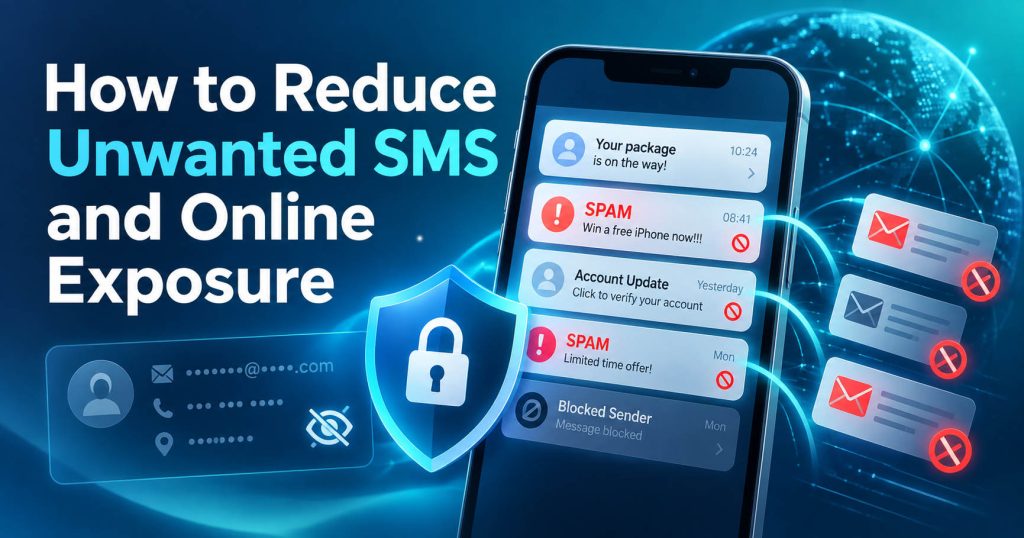
Why Are You Receiving More and More Unwanted SMS Messages?
One of the most common reasons why users start receiving more unwanted SMS messages is that their phone number has been provided to too many different websites, applications, or services. Every time you enter your phone number into a registration form, promotional program, e-commerce website, marketplace, or social media account, you are creating another storage point for your contact information. Over time, if this is not properly controlled, the same phone number may exist in many different data systems.
In addition, some services may share data with third-party partners under privacy policies that users have agreed to when registering. This does not mean that every website sells or distributes data, but in practice, a phone number may be used for marketing, advertising measurement, or other communication activities beyond the original purpose. When data passes through multiple systems, the possibility of the phone number appearing in marketing lists or external data sources also increases.
Another cause is a security incident. If a platform that previously stored your phone number experiences a data breach, that information may be added to databases that are exchanged, sold, or used for future spam campaigns. Users often do not know exactly where their phone number was exposed, but a sudden increase in advertising messages, unfamiliar calls, or fraudulent SMS messages can sometimes be a sign that their contact information has been distributed.
In addition, today’s automated SMS systems can send large volumes of messages within a short period of time. Spammers do not necessarily use one fixed number; they may change senders, use fake brand names, or use many different numbers. Therefore, blocking individual numbers sometimes only solves a small part of the problem. This is also why users should combine multiple measures instead of relying only on the blocking feature.
Are Unwanted SMS Messages Dangerous?
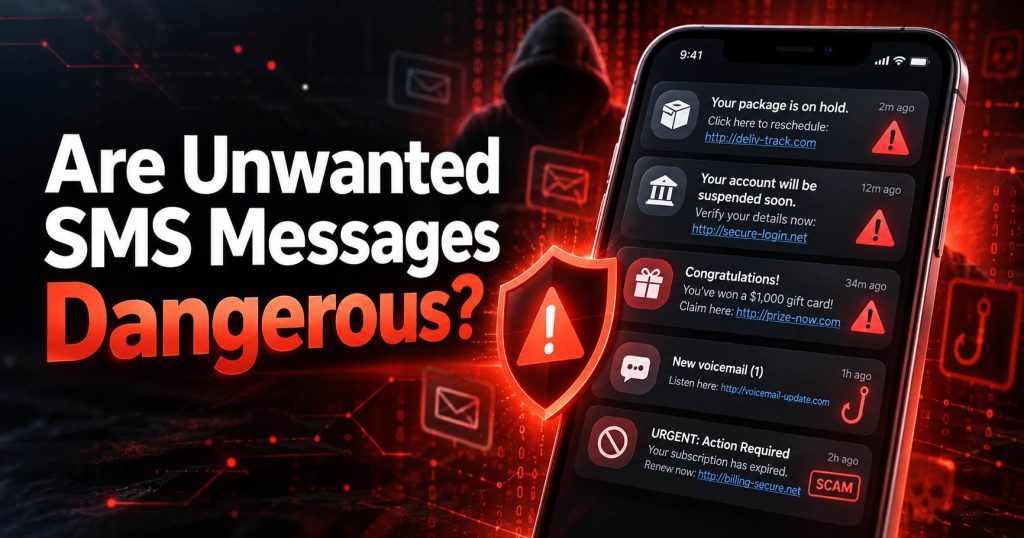
Not every unwanted message is dangerous, but users need to distinguish between ordinary spam and scam messages. SMS spam usually includes unsolicited advertisements, product offers, or promotions. Meanwhile, scam SMS or smishing has a more direct objective, such as tricking users into clicking fake links, providing account information, entering an OTP, or transferring money.
Smishing is a form of phishing conducted through SMS. Scammers often impersonate banks, delivery companies, government agencies, e-commerce platforms, or familiar services to create a sense of urgency. A message may state that an account is about to be locked, that there is an unusual transaction, that an order has encountered a problem, or that the user has won a prize. The goal is to make the recipient act quickly before having time to verify the authenticity of the message.
If users click on unfamiliar links, they may be redirected to a fake website with an interface that closely resembles the real one. There, information such as usernames, passwords, card numbers, or OTPs may be collected. In more serious cases, the link may lead to a malicious file or request the installation of an untrusted application.
Therefore, the goal of reducing SMS spam is not only to keep the inbox cleaner but also to reduce the number of times users are exposed to situations that may involve scams.
How to Effectively Reduce SMS Spam
The first and simplest step is not to respond to suspicious messages. For messages from unknown sources, especially if the content asks you to take urgent action, provide an OTP, verify information, or click a link, responding usually provides no benefit. In some cases, replying may let the sender know that the phone number is active and that someone is reading the messages.
Users should also avoid clicking links in unfamiliar SMS messages. If a message reports an issue related to a bank, shopping account, or delivery service, a safer approach is to open the official application yourself or type the website address directly into the browser. This helps avoid accessing fake websites designed to steal information.
The block sender feature is still very useful, especially for numbers that frequently send unwanted content. On most phones today, users can open the conversation, view the sender information, and block it directly. However, because spammers can change numbers or senders, blocking should not be considered the only measure.
Another layer of protection is to enable the spam filters available on the phone. On iPhone, the unknown sender filtering feature can separate messages from unfamiliar numbers from the main list. On many Android devices, the Messages app can automatically detect and label suspicious content. These tools are not perfect, but they can significantly reduce the number of unwanted SMS messages that appear directly in front of users.
Reporting spam should also be done if the platform or carrier supports it. When a message is marked as spam, that data may help improve filtering systems for other users. However, for messages that are clearly fraudulent, users should prioritize not interacting with them and use the available reporting function instead of replying directly.
Reduce the Online Exposure of Your Phone Number
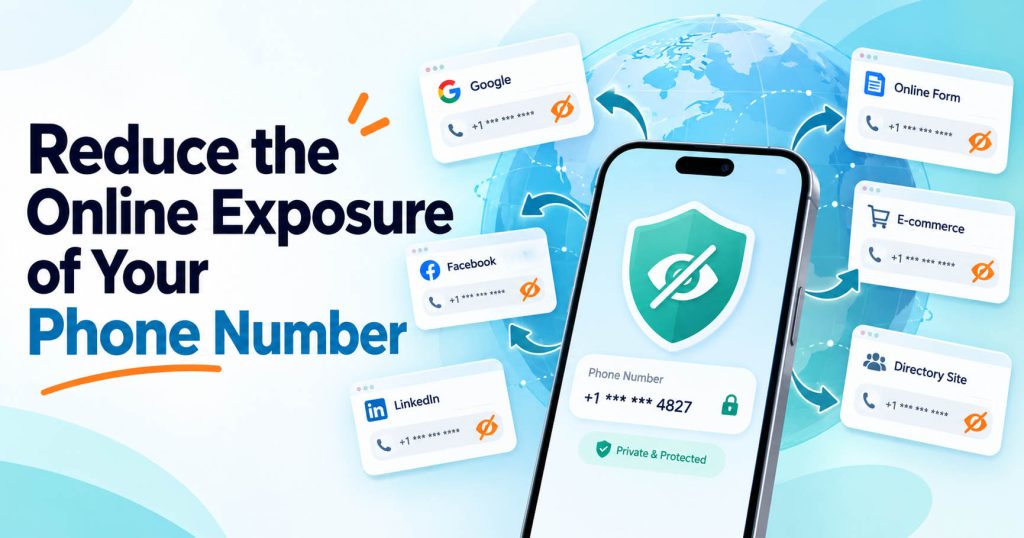
To reduce SMS spam in the long term, users need to reduce the number of places where their personal phone number is stored or publicly displayed. This is the part that is often overlooked when people focus only on blocking messages after they have already appeared.
First, check whether your phone number is publicly displayed on social media, old profiles, forums, sales pages, marketplaces, or personal websites. Many people may have publicly shared their phone number years ago but forgotten to remove it, while that data may still be accessible to search engines or data-collection systems.
Users should also limit entering their phone number into forms that do not truly require it. Before providing the information, ask yourself whether the website actually requires a phone number, whether the field can be skipped, and whether the account really needs to be used long term. If the phone number is only requested for a marketing campaign or to receive promotional information, providing your primary number may create an additional risk of receiving spam later.
Another useful habit is to quickly read the privacy policy of important platforms, especially the sections related to using data for marketing and sharing it with third parties. You do not need to read the entire legal document, but you should pay attention to sections describing how phone numbers are collected, stored, and used.
The principle of data minimization is also very important. Simply put, only provide the information that is truly necessary for the purpose at hand. If a website does not need your phone number to provide the service, you should not automatically provide it just because the form contains an input field.
Separate Phone Numbers by Purpose of Use
An effective way to reduce unwanted SMS messages is to avoid using the same phone number for all online activities.
Your primary phone number should be prioritized for services with long-term value, such as banking, your primary email, work, family, and accounts that may need to be recovered in the future. These are situations where stability, long-term control, and the ability to receive OTPs after months or years are more important than flexibility.
Meanwhile, for temporary activities such as trial registrations, receiving coupons, participating in promotional programs, posting listings on marketplaces, or verifying a service that does not need to be used long-term, users may consider using a secondary number or a temporary phone number if the platform allows it.
This separation helps limit the number of places where your primary phone number appears, while also reducing the possibility that marketing campaigns or spam related to short-term activities will continue to be sent directly to your personal number.
Can a Temporary Phone Number Help Reduce SMS Spam?
In many cases, yes. However, it is important to understand its nature correctly.
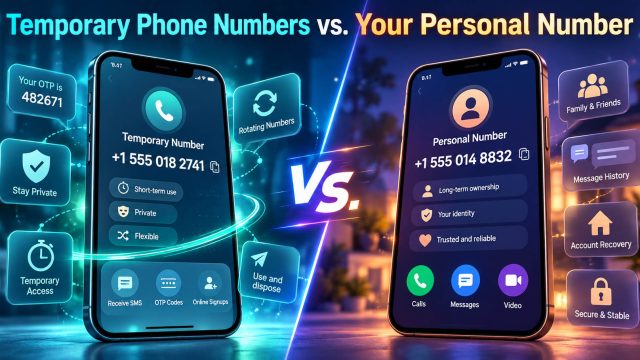
A temporary phone number is not a tool that can block all spam or make users completely anonymous. Its main value lies in creating an intermediate layer between your personal number and websites or applications that only need a phone number for a short period of time.
Need a Virtual Number Right Now?
Skip the wait — rent an instant virtual number and start receiving SMS codes in seconds.
For example, instead of using the same primary number to register for dozens of services, users can keep their primary number for important accounts and use a temporary number for activities with a higher level of exposure. When the temporary number is no longer used, subsequent marketing messages or other content generated from those activities will not be sent directly to the personal number.
A temporary number is particularly useful for cases such as trial registrations, application testing, receiving OTPs for short-term accounts, or verifying a service that is only used once. However, it should not be used for banking, primary email, government accounts, or services that require long-term account recovery.
In addition, users also need to distinguish between public and private numbers. A Public SMS inbox may display messages for multiple people to view, so it is completely unsuitable for sensitive data. A Private temporary number usually provides better control during the rental period, but it still needs to be used for the appropriate purpose.
SMS Nova Expert Advice: Don’t Just Block Spam, Reduce Exposure at the Source
From SMS Nova’s perspective, one of the most common mistakes is that users only start taking action after spam has already appeared. At that point, blocking the sender or deleting the message only addresses the immediate symptom. If the personal phone number continues to be entered on many new websites every week, the risk of receiving more spam in the future remains.
A more effective approach is to reduce exposure from the beginning. Every time you are about to provide your phone number, you should consider whether the account is actually important, whether you will need to access it after one year, and whether the number will be used for account recovery. If the answer to all of these questions is no, using your primary number may not be necessary.
SMS Nova also recommends not viewing a temporary phone number as a tool for achieving “complete anonymity.” A website can still collect cookies, IP addresses, email addresses, device data, or other information. The practical value of a temporary number lies in data minimization, meaning reducing the number of places where your personal number is stored.
Another important point is that a temporary number should not be used for long-term account recovery. If the number expires or is recycled, users may no longer be able to receive OTPs or verification codes in the future. Therefore, each type of number should have a clearly defined role. A primary number is suitable for identity, recovery, and long-term accounts; a secondary number is suitable for separating communications; while a temporary number is more suitable for short-term verification and controlling the level of exposure.
Mistakes That Increase SMS Spam
One common mistake is responding to suspicious messages just to ask who the sender is. With an unknown source, this action may confirm that the number is active.
Another mistake is clicking an “unsubscribe” link in every SMS. For legitimate marketing campaigns, the unsubscribe mechanism may be safe. However, with messages from unknown sources or messages showing signs of fraud, clicking any link can increase the risk.
Making your phone number publicly visible on Facebook, forums, or marketplaces is also a common reason for increased exposure. Old posts can still be found through search engines or copied to other places, so you should periodically check content where you have previously made your number public.
In addition, unnecessary access to your contacts should also be limited. Many apps request access to contacts to support friend-connection features, but if you do not actually use those features, this permission can be disabled.
10-Minute Checklist to Reduce SMS Spam and Information Exposure
If you want to take quick action, you can start by enabling the spam filter on your phone, blocking and reporting suspicious senders, and checking whether your phone number is publicly visible on social media. Then, remove your number from old accounts that you no longer use, disable contact synchronization permissions in unnecessary applications, and review the services that are currently using your primary number for non-essential purposes.
Next, establish a clear rule for how you use your numbers. Use your primary number only for important and long-term accounts; use a secondary or temporary number for short-term activities when appropriate. This change in habits alone can significantly reduce the number of places where your personal number is stored.
Frequently Asked Questions
Why Am I Suddenly Receiving a Lot of SMS Spam?
The reason may be that your phone number has been registered with many services, publicly appeared on the Internet, been added to a marketing database, or appeared in a data breach. It is not always possible to determine the exact source.
Is Replying STOP Safe?
If the message comes from a legitimate brand that you previously subscribed to, STOP may be a way to unsubscribe from receiving further information. However, for unfamiliar messages or messages suspected of being fraudulent, it is better not to respond and instead use the block or report function.
Does Blocking a Number Completely Stop Spam?
No. Spammers may use different numbers or multiple senders. Blocking is useful, but it should be combined with spam filtering and reducing the exposure of your phone number.
Should I Click a Link in an Unfamiliar SMS?
No. If the message is related to a bank, an order, or an account, open the official app or website directly instead of using the link in the SMS.
How Can I Tell Whether My Phone Number Has Been Exposed?
You can search for your phone number on the Internet, check old profiles, and see whether the number appears on public websites. An unusual increase in spam can also be a sign, but it is not enough to determine the exact source of the leak.
Can a Temporary Phone Number Help Reduce Spam?
It can help reduce spam sent to your primary number if it is used for short-term activities with a higher level of exposure. However, it cannot prevent all spam.
Should I Use a Temporary Phone Number for Banking?
No. Banks and financial services require a stable number to receive OTPs, security alerts, and support account recovery.
Is a Public SMS Inbox Safe?
It is not suitable for sensitive data because messages may be accessible to multiple people. If you need a higher level of privacy, you should use a private number.
Reference sources:
https://consumer.ftc.gov/articles/how-recognize-and-report-spam-text-messages
https://consumer.ftc.gov/consumer-alerts/2025/01/dealing-spam-texts-emails-junk-mail
https://www.cyber.gc.ca/en/guidance/smishing-protect-yourself-sms-attacks-itsap00103
https://www.ctia.org/protecting-yourself-from-spam-text-messages
Conclusion
To reduce SMS spam and limit unwanted SMS messages, users need to combine blocking, reporting, message filtering, and reducing the exposure of their phone number on the Internet. More importantly, use your primary number selectively, avoid providing it to unnecessary services, and consider using a secondary or temporary number for short-term activities. This is a more effective way to reduce spam at the source instead of simply dealing with each message after it appears.
Need a Virtual Number Right Now?
Skip the wait — rent an instant virtual number and start receiving SMS codes in seconds.

 Apple
Apple  Telegram