Need a Virtual Number Right Now?
Skip the wait — rent an instant virtual number and start receiving SMS codes in seconds.
Things to Know Before Using a Temporary Phone Number · 1:57
Transcript
Temporary phone number are becoming increasingly popular when users need to receive SMS messages, OTP codes, verify accounts, or test a service without wanting to provide their personal phone number. However, convenience does not mean that every temporary number is suitable for every situation. If you choose the wrong type of number, use a rental period that is too short, or use a public inbox for sensitive data, you may face risks related to privacy, loss of account access, or failure to receive verification codes as expected. Therefore, before using a temporary phone number, the most important thing is to clearly understand what you need the number for, how long you will be able to control the number, whether the inbox is public or private, and whether the account may require re-verification in the future. 10 Important Things to Know Before Using a Temporary Phone Number Before choosing a temporary phone number, users should view it as a tool with a limited lifecycle rather than a complete replacement for a personal phone number. The most important factors to check include the purpose of use, the country of the number, whether the number is mobile or VoIP, the rental period, the ability to receive OTPs, compatibility with the platform, whether the inbox is public or private, the number recycling policy, the provider's privacy policy, and payment or refund conditions. If even one of these factors is unsuitable, the user experience may be affected. For example, if an account may require an SMS after six months but you only rent the number for a few minutes, the initial verification may be successful, but account recovery later can become a problem. First, Understand What a Temporary Phone Number Really Is A temporary phone number is a phone number provided for a limited period of time or for a specific purpose.
Temporary phone number are becoming increasingly popular when users need to receive SMS messages, OTP codes, verify accounts, or test a service without wanting to provide their personal phone number. However, convenience does not mean that every temporary number is suitable for every situation. If you choose the wrong type of number, use a rental period that is too short, or use a public inbox for sensitive data, you may face risks related to privacy, loss of account access, or failure to receive verification codes as expected.
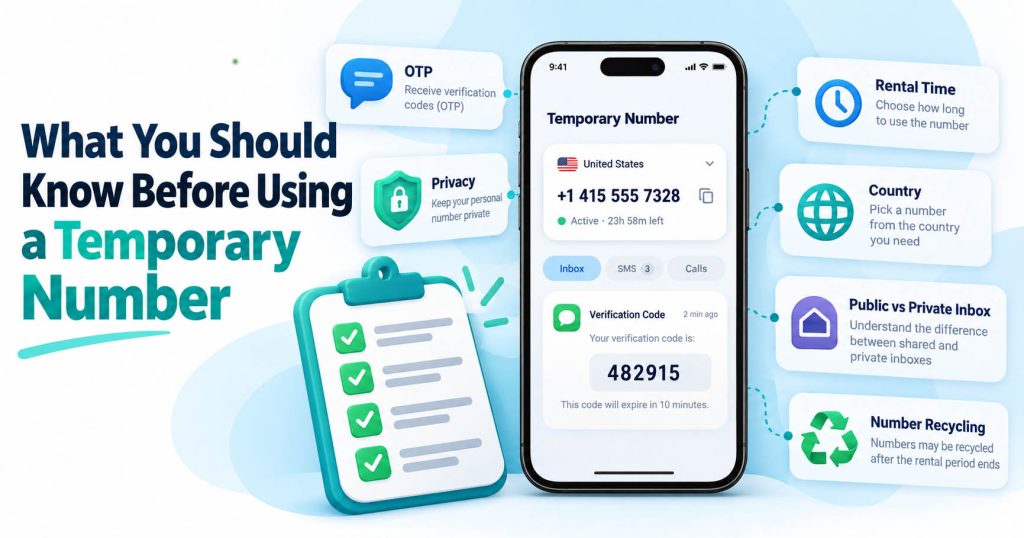
Therefore, before using a temporary phone number, the most important thing is to clearly understand what you need the number for, how long you will be able to control the number, whether the inbox is public or private, and whether the account may require re-verification in the future.
10 Important Things to Know Before Using a Temporary Phone Number
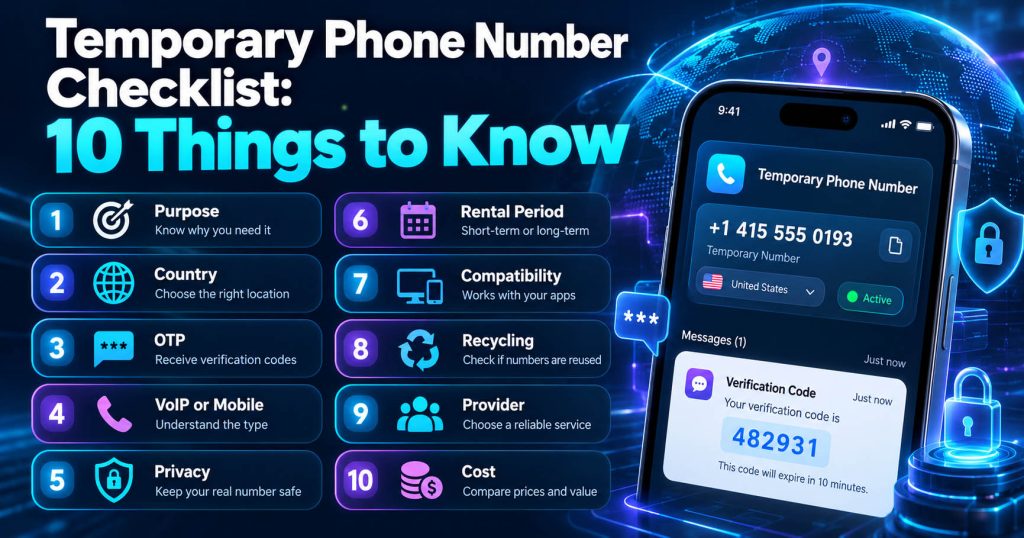
Before choosing a temporary phone number, users should view it as a tool with a limited lifecycle rather than a complete replacement for a personal phone number. The most important factors to check include the purpose of use, the country of the number, whether the number is mobile or VoIP, the rental period, the ability to receive OTPs, compatibility with the platform, whether the inbox is public or private, the number recycling policy, the provider’s privacy policy, and payment or refund conditions.
If even one of these factors is unsuitable, the user experience may be affected. For example, if an account may require an SMS after six months but you only rent the number for a few minutes, the initial verification may be successful, but account recovery later can become a problem.
First, Understand What a Temporary Phone Number Really Is
A temporary phone number is a phone number provided for a limited period of time or for a specific purpose. In many cases, users use this number to receive SMS messages, OTPs, or verification codes without having to provide their primary phone number to a website or application.
The lifespan of a temporary number can vary significantly. Some numbers can only be used for a few minutes to receive a single OTP, while others can be rented for a few hours, several days, or longer.
It is important not to equate a temporary phone number with a virtual phone number. A virtual phone number is a broader concept because a virtual number can be maintained for a long period of time and does not necessarily have to be revoked after completing a single verification. Meanwhile, a temporary phone number emphasizes a limited usage period.
A disposable number generally implies an even shorter-term use, often serving only one registration or verification. A burner number can also be used for a limited period, but it usually emphasizes the ability to separate the primary number from other activities.
Is a Temporary Phone Number a Fake Number?
A temporary number should not be called a “fake number.” Many temporary numbers are real numbers connected to telecommunications systems or carriers, but usage rights are provided for a specific period of time.
The main difference does not lie in whether the number is “real,” but in the control and lifecycle of the number. Users can receive SMS messages during the period for which the number is provided, but this does not mean that they own the number permanently.
Clearly Determine What You Need the Phone Number For
Before renting or choosing a number, the first question should be: What do I need this number for? If the purpose is simply to receive one OTP to complete a short-term registration, a number that only exists for a short period may meet the need. However, if the website may send additional verification codes later, a number that only exists for a few minutes can create risks.
For accounts that need to be used for several days, users should consider a number with a longer rental period so that they can still receive SMS messages when re-verification is required. Meanwhile, for accounts that need to be maintained for several months or years, a temporary number is generally not a suitable choice.
Developers or QA testers have a different need. When testing SMS processes, OTPs, signup flows, or user onboarding, temporary numbers can be very useful because they allow users to test multiple scenarios without continuously using personal numbers.
It is clear that the same type of number cannot be suitable for every purpose. A number that is suitable for one-time verification may not necessarily be suitable for account recovery.
Check the Usage Period Before Renting the Number
The rental period is one of the most commonly overlooked factors. A one-time-use number can be perfectly suitable if you are certain that you only need one OTP. However, if the account may send SMS messages later, users should choose a number rented by the hour, by the day, or for a longer period.
A very useful question to ask before choosing a number is: Can this website or application send an SMS to the same number after today?
If the answer is yes, avoid numbers with an overly short lifecycle. This is especially important for accounts with security checks, logins on new devices, or re-verification requirements after changing a password. Successful verification today does not mean that you will not need the number in the future.
Not Every Temporary Phone Number Can Receive OTPs
A fairly common misconception is that simply having a temporary phone number means you will definitely receive every SMS verification message.
In reality, the ability to receive verification codes depends on many factors. Some numbers may only receive regular SMS messages, while others may be better able to receive A2P messages or OTPs.
The type of number is also very important. Mobile numbers and VoIP numbers may be handled differently by platforms. Some websites have systems that detect virtual numbers or disposable numbers and reject them during the registration process.
Therefore, users should not trust advertisements such as “works everywhere” or “works with all apps.” No temporary phone number is guaranteed to work with every platform.
A more accurate way to put it is: the ability to receive OTPs depends on the platform, country, number type, and verification policy at the time of use.
The Country of the Phone Number Is Also Very Important
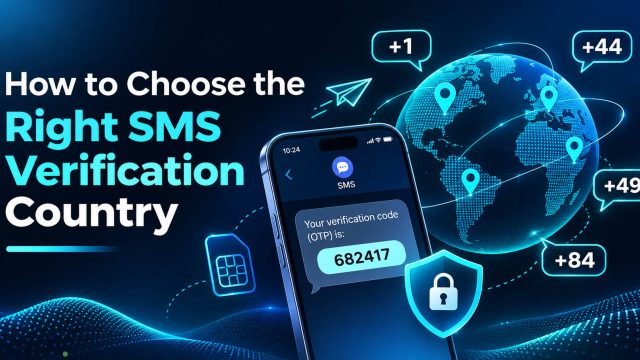
The country code is not merely a formal detail; in some cases, it can directly affect verification. For example, numbers beginning with +44 belong to the United Kingdom, +49 to Germany, +33 to France, +31 to the Netherlands, and +34 to Spain. Some platforms may require a number that matches the account’s region or may support verification better in certain countries.
Therefore, you should not choose a country simply because it is cheaper. A low-cost number that is not compatible with the service requiring verification is still an ineffective choice.
Users should check which countries the platform supports, which types of numbers are accepted, and whether the SMS route is stable. If using a number long-term, you should also keep in mind that subscriber registration regulations may differ from country to country.
What Is Number Recycling and Why Should You Care?
Number recycling is the process in which a phone number is reclaimed after a user stops using it and then reassigned to someone else. This is one of the most important issues to understand before using a temporary number.
When the rental period ends, the number may return to the pool. If an old account still keeps that number as a recovery method, the platform may continue sending OTPs, security alerts, or password reset codes to a number that you no longer control.
If the number is reassigned to someone else, the new user may receive SMS messages sent to the old number. This does not mean that they can automatically access the account, but it creates a risk that users should not overlook. Therefore, a temporary number should not be used as a recovery number for a primary email account or an important account.
Accounts That Should Not Use Temporary Phone Numbers
Temporary phone numbers are not suitable for accounts that you need to maintain long-term access to. Banking is the clearest example. A bank account may use a phone number to send transaction OTPs, security alerts, fraud alerts, or support account recovery. A number that may expire after a few hours is not a suitable choice.
The same applies to PayPal, e-wallets, and financial services. If an account has financial value, you should use a stable number that you can control over the long term.
A primary email account should also not use a temporary number as a recovery method because email is often the recovery center for many other accounts.
Government accounts, important work accounts, or long-term 2FA also require a phone number with a more stable lifecycle. A very simple principle to remember is: if losing the account would cause a major problem, use a number that you can control over the long term.
When Is a Temporary Phone Number More Suitable?
Temporary numbers are particularly suitable for activities with a short usage period. For example, users may consider this type of number when registering for a trial service, participating in a marketing program, receiving a coupon, or using an online tool for only a short period of time.
Developers and QA testers can also use temporary numbers for SMS testing, OTP testing, or signup flows. A marketplace is another situation. If you want to create a layer of separation between strangers and your personal phone number, a secondary or temporary number may be suitable depending on the purpose.
In addition, a temporary number can be used for one-time verification when the platform supports it and the account does not need to receive SMS in the future.
To What Extent Does a Temporary Phone Number Protect Privacy?
One of the clearest benefits is that the website does not need to know your primary phone number. Instead of using the same personal number across dozens of platforms, users can use a temporary number for short-term activities.
This helps reduce data exposure and limits the possibility of a single identifier appearing in too many different databases. However, a temporary number does not make users completely anonymous. A website can still collect your IP address, cookies, email address, browser fingerprint, payment information, or account information.
Therefore, a temporary phone number should be viewed as a data minimization tool. Its value lies in reducing the amount of personal data that needs to be shared, rather than turning the user into an identity that cannot be traced at all.
Need a Virtual Number Right Now?
Skip the wait — rent an instant virtual number and start receiving SMS codes in seconds.
Check the Provider Before Buying or Renting a Number
Before using a temporary number service, users should check the provider’s level of transparency. A trustworthy provider should have a clear privacy policy explaining how SMS messages are processed and how long the data is stored.
Users should also know whether the inbox is public or private, how long they will retain control of the number, and how the number will be handled after it expires.
The number recycling policy is also very important, especially if you plan to keep the account after the initial verification. In addition, the provider should have contact information, terms of use, and a support mechanism. Websites that provide almost no legal information, have no contact information, or do not clearly explain how data is handled should be approached with caution.
Check the Cost and Refund Conditions
A low price is not always the best choice. Free temporary numbers often come with trade-offs such as public inboxes, shared numbers, or a higher blocking rate. Pay-per-code may be suitable if you only need one OTP. A rental number is more suitable when you need to keep the number for several hours or days.
Before making a payment, you should check the policy for situations where the SMS does not arrive. Users need to know whether they can change the number, whether a refund is available, and what the maximum waiting time is. This helps avoid paying for a number that is not compatible with the platform requiring verification.
Is Using a Temporary Phone Number Legal?
You should not give the same answer for every country because legal regulations may differ. In general, using a temporary number or virtual number for legitimate privacy, communication, testing, or verification purposes is not usually a problem. However, users must still comply with local laws and the Terms of Service of each platform.
What needs to be distinguished is the technology and the purpose for which it is used. A temporary number should not be used for fraud, identity impersonation, harassment, or intentionally bypassing mandatory KYC processes.
7 Common Mistakes When Using Temporary Phone Numbers
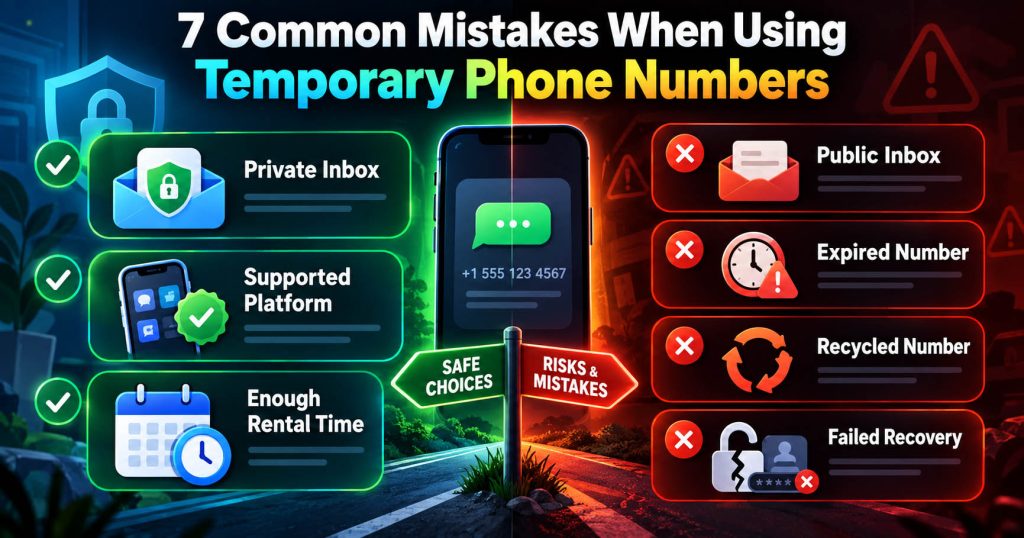
The first mistake is using a public number for important OTPs. If the inbox is public, the code may be visible to other people. The next mistake is not checking the rental period. A number with a lifecycle of only a few minutes should not be used for an account that requires re-verification.
Many people also use a temporary number for account recovery without considering that the number may be reclaimed. This is a risky choice. Another mistake is assuming that all temporary numbers are the same. Public, shared, and private numbers have very different levels of privacy.
In addition, choosing a number simply because it is cheap can also cause users to encounter compatibility or stability issues. You should not assume that a temporary number will work with every website, nor should you assume that using a temporary number means being completely anonymous.
Checklist Before Using a Temporary Phone Number
Before using a number, users should ask themselves what they need the number for, whether they need to receive SMS after today, whether the inbox is public or private, whether the number is mobile or VoIP, and whether the platform supports that type of number.
You should also know how long you will be able to control the number, whether the number will be recycled, whether the account contains sensitive data, and whether losing the number tomorrow would also mean losing access to the account.
Finally, check whether the provider has a clear privacy policy and terms of use. If you cannot answer these questions, it may be better not to use a temporary number yet.
SMS Nova Expert Assessment: A Temporary Phone Number Is Not a One-Size-Fits-All Solution
Based on SMS Nova’s experience, the biggest mistake is not using a temporary phone number, but choosing a number with a lifecycle that is too short for an account that needs to be used long-term.
A temporary number is most suitable for short-term verification, testing, trial accounts, or services that only require one-time verification and allow virtual numbers. In contrast, bank accounts, primary email accounts, PayPal, long-term 2FA, or account recovery should use a stable phone number.
SMS Nova also recommends that users prioritize a private number when the SMS content is valuable or requires a higher level of privacy. A public inbox may be convenient, but it is not suitable for sensitive data.
Another point to keep in mind is that a low price should not be the only criterion. When choosing a temporary number, users should evaluate privacy, compatibility, rental period, reliability, and control over the number at the same time.
From a privacy protection perspective, a temporary number should be viewed as a data minimization tool. Its real value is helping users avoid having to provide their personal phone number to every service on the Internet.
For short-term OTP receiving, testing, or registration on platforms that support virtual numbers, users may consider a temporary phone number from SMS Nova to reduce the need to share their primary number.
However, the ability to receive verification codes always depends on the platform, country, number type, and verification policy at the time of use. A temporary number should not replace a personal number for financial services or long-term account recovery.
Temporary Phone Number or Personal Phone Number – Which Should You Choose?
There is no single choice that is suitable for every situation. If the purpose is simply to receive an OTP once, test an application, or use a short-term account, a temporary number may be suitable.
If the account is related to banking, a primary email, long-term 2FA, or account recovery, a personal phone number is more suitable because it provides stable control.
The important difference lies in the account lifecycle. A temporary number addresses short-term needs, while a personal number is more suitable for long-term identity and recovery.
Frequently Asked Questions
Can a Temporary Phone Number Receive OTPs?
It can. However, the ability to receive OTPs depends on the type of number, the country, and the platform’s policies.
How Long Can a Temporary Number Be Used?
It depends on the provider. Some numbers can only be used for a few minutes, while others can be rented for several hours, several days, or longer.
Can a Temporary Number Be Reused by Someone Else?
It can. After the rental period ends, the number may be returned to the pool and assigned to someone else.
Can Other People See My SMS Messages?
If you use a public SMS inbox, they may be able to. With a private number, access is generally more restricted.
Is a Free Temporary Number Safe?
The level of safety depends on the type of service. Free numbers generally have a higher risk of public inboxes or shared use.
How Is a Private Temporary Number Different from a Public Number?
A private number usually has a private inbox during the rental period, while a public number may display SMS messages to multiple people who access it.
Does a Temporary Number Work With Every Website?
No. Some platforms block virtual, VoIP, or disposable numbers.
Should You Use a Temporary Number for 2FA?
It is not recommended if the 2FA needs to be used long-term. You may lose the ability to receive codes when the number expires.
Should You Use a Temporary Number for Banking or PayPal?
It is not recommended. Financial services require a stable number to support security and account recovery.
What Happens When a Temporary Number Expires?
You may lose the ability to receive SMS messages, and the number may be reassigned to someone else.
Does a Temporary Number Help Hide Your Real Number?
It can help prevent a website from knowing your primary phone number, but it does not make you completely anonymous.
Is Using a Temporary Phone Number Legal?
In many cases, it is legal, but users must still comply with local laws and the terms of each platform.
Reference sources:
https://zubasms.com/blog/everything-you-need-to-know-before-buying-a-temporary-phone-number
https://readynum.com/blog/temporary-phone-numbers-explained
https://binotp.com/en/blog/temporary-phone-number-privacy-a-safe-use-guide
https://recyclednumbers.cs.princeton.edu/
Need a Virtual Number Right Now?
Skip the wait — rent an instant virtual number and start receiving SMS codes in seconds.

 Apple
 Telegram