Need a Virtual Number Right Now?
Skip the wait — rent an instant virtual number and start receiving SMS codes in seconds.
What Is SMS Spoofing? Risks and Prevention Tips · 2:07
Transcript
You receive a message from a familiar bank, notifying you that your account is experiencing a problem and asking you to click a link to verify your identity. What is concerning is that the message displays the bank's exact name and may even appear in the previous SMS conversation. Is this really an official notification? This could be a sign of SMS Spoofing, a technique used to falsify the sender information of a text message, making the recipient trust an identity that does not match the actual source of the message. Scammers may exploit SMS Spoofing to impersonate banks, mobile carriers, delivery companies, or other trusted organizations. Their goal is usually to steal passwords, OTP codes, personal information, or trick users into carrying out financial transactions. So, what is SMS Spoofing, how does it work, and how can you recognize spoofed messages? The following article will explain common risks and provide preventive measures to help you protect your phone number and online accounts. What Is SMS Spoofing? SMS Spoofing is a technique for falsifying SMS sender information, causing the recipient to see a phone number or brand name that differs from the actual identity of the sender. Normally, when receiving an SMS, the phone displays the sender's phone number or name at the top of the conversation. This information is called the Sender ID. Scammers can exploit limitations in Sender ID authentication to make a message look as though it was sent by a legitimate organization. For example, a spoofed message may display the name EXAMPLEBANK, along with a warning that the bank account has been locked and a request for the user to visit a link. If they trust the sender's name completely, victims may click on a fake website and unknowingly provide their login information. What Is an SMS Sender ID? Sender ID is the sender identification information displayed on the device receiving an SMS.
You receive a message from a familiar bank, notifying you that your account is experiencing a problem and asking you to click a link to verify your identity. What is concerning is that the message displays the bank’s exact name and may even appear in the previous SMS conversation. Is this really an official notification?
This could be a sign of SMS Spoofing, a technique used to falsify the sender information of a text message, making the recipient trust an identity that does not match the actual source of the message.
Scammers may exploit SMS Spoofing to impersonate banks, mobile carriers, delivery companies, or other trusted organizations. Their goal is usually to steal passwords, OTP codes, personal information, or trick users into carrying out financial transactions. So, what is SMS Spoofing, how does it work, and how can you recognize spoofed messages? The following article will explain common risks and provide preventive measures to help you protect your phone number and online accounts.
What Is SMS Spoofing?
SMS Spoofing is a technique for falsifying SMS sender information, causing the recipient to see a phone number or brand name that differs from the actual identity of the sender.
Normally, when receiving an SMS, the phone displays the sender’s phone number or name at the top of the conversation. This information is called the Sender ID. Scammers can exploit limitations in Sender ID authentication to make a message look as though it was sent by a legitimate organization.
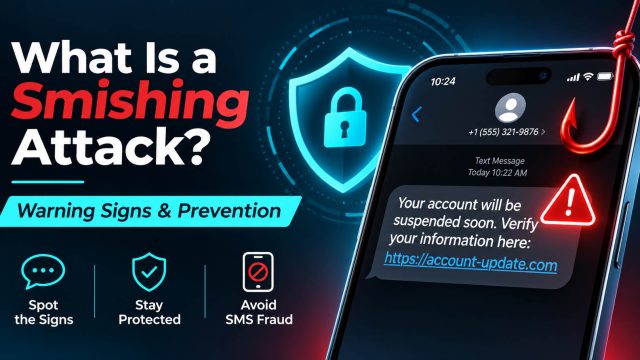
For example, a spoofed message may display the name EXAMPLEBANK, along with a warning that the bank account has been locked and a request for the user to visit a link. If they trust the sender’s name completely, victims may click on a fake website and unknowingly provide their login information.
What Is an SMS Sender ID?
Sender ID is the sender identification information displayed on the device receiving an SMS.
A Sender ID can appear in several common forms:
- Phone Number: A regular phone number.
- Short Code: A short number used for messaging services.
- Alphanumeric Sender ID: A sender name combining letters and numbers, commonly used by businesses.
For example, a business may send notifications with the Sender ID SHOPALERT instead of a phone number. Using a customized Sender ID is not necessarily fraudulent. Many legitimate businesses use their brand names to help customers identify the source of a message. The problem arises when someone deliberately impersonates another organization to carry out fraudulent activities.
How Does SMS Spoofing Work?
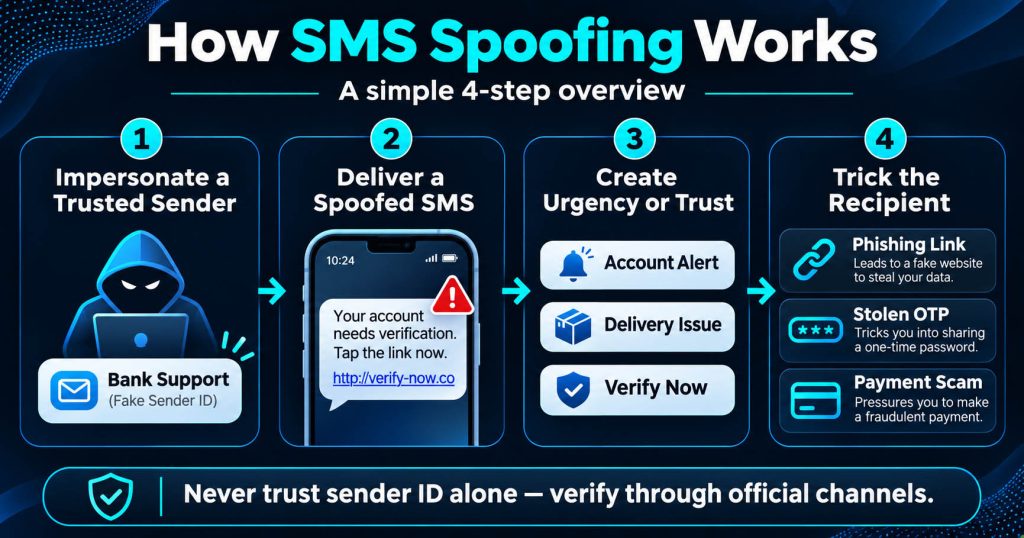
To understand how SMS Spoofing works, it is necessary to distinguish between the message content and the sender identification information. In some messaging systems, sender information is transmitted along with SMS data. If the sender’s identity is not verified rigorously enough, a message may appear under a misleading name or phone number. An SMS Spoofing attack intended for fraud usually takes place in four stages.
Step 1: Impersonating a Trusted Sender
Scammers try to make a message display an identity resembling that of a bank, business, mobile carrier, or familiar organization. The purpose is to create a sense of trust as soon as users see the notification.
Step 2: Sending a Spoofed Message
The message is delivered to the victim’s device through a messaging system. In some cases, an SMS application may group spoofed messages into the same conversation as legitimate messages with a matching Sender ID. This makes it difficult for recipients to distinguish the source based solely on the conversation interface.
Step 3: Creating a Sense of Urgency
The message content often uses situations that create pressure:
- The bank account has been locked.
- An unusual transaction has been detected.
- The order cannot be delivered.
- Personal information needs to be updated.
- The account must be verified immediately.
These notifications are intended to make recipients act quickly without checking carefully.
Step 4: Tricking Users into Taking Action
Scammers may ask victims to visit fake websites, provide login information, disclose OTP codes, or transfer money. It is important to note that SMS Spoofing does not automatically allow scammers to read messages on a phone or take control of a SIM card. The risks usually arise when victims trust the message and follow fraudulent instructions.
5 Common Types of SMS Spoofing
SMS Spoofing can appear in many different forms. These attacks often exploit brands and services that users are already familiar with.
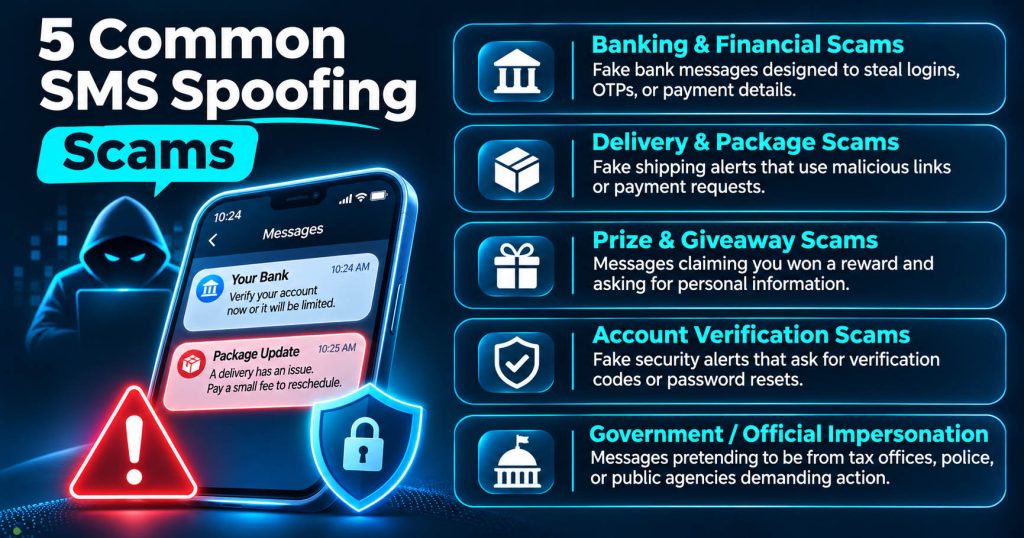
1. Bank Message Spoofing
This is a dangerous form because it directly involves financial accounts. Victims may receive messages notifying them that a suspicious transaction has been detected and asking them to access a link to verify or cancel the transaction. Fake websites often have interfaces resembling those of real banks in order to collect usernames, passwords, or payment information.
2. Delivery Company Spoofing
Messages may notify recipients that an order could not be delivered, that the address is incorrect, or that an additional delivery fee must be paid. Recipients are instructed to visit a website to update their information. If the website is fake, address details, phone numbers, and payment card information may be stolen.
3. Government Agency Spoofing
Scammers use the identities of tax authorities or public service agencies to send notifications about fines, payment obligations, or identity verification requests. These administrative-style notifications often make recipients worried and more likely to follow the instructions.
4. OTP Notification Spoofing
A message may impersonate an online platform, notify users of an unusual login request, and instruct them to provide an OTP to protect their account. In reality, scammers are trying to collect the verification code to carry out an unauthorized action. Do not share OTP codes with anyone claiming to be a support representative.
5. Impersonating Friends or Colleagues
Some attacks impersonate acquaintances, colleagues, or managers to request money transfers or internal data. This form may combine SMS Spoofing with psychological manipulation techniques (Social Engineering).
Distinguishing SMS Spoofing, Smishing, and SIM Swapping
These three terms are all related to phone security, but they operate through different mechanisms.
SMS Spoofing and Smishing
SMS Spoofing is the act of falsifying sender information.
Meanwhile, Smishing (SMS Phishing) is a form of fraud carried out through text messages to trick recipients into providing information, clicking links, or taking harmful actions. A Smishing attack may use SMS Spoofing to increase credibility. However, not all scam messages use a spoofed Sender ID.
SMS Spoofing and SIM Swapping
SIM Swapping is the act of taking control of a phone number by transferring it to a SIM card or eSIM controlled by a scammer without authorization. After taking over the number, scammers may receive new calls and SMS messages sent to the victim’s phone number. SMS Spoofing is different in that it falsifies the displayed identity of the sender without necessarily taking control of the number.
| Criteria | SMS Spoofing | Smishing | SIM Swapping |
|---|---|---|---|
| Mechanism | Impersonating the sender | Fraud through SMS | Taking control of a phone number |
| Objective | Creating trust | Stealing data or money | Receiving SMS messages and calls |
| Requires SIM takeover | No | No | Involves unauthorized number transfer |
| OTP risk | Tricking victims into disclosing codes | Stealing codes through fraud | Receiving codes sent to the hijacked number |
Distinguishing between these types of attacks helps users choose more appropriate preventive measures.
The Dangerous Risks of SMS Spoofing
A successful SMS Spoofing attack can cause many consequences, ranging from personal information exposure to financial losses.
Personal Information Theft
Fake messages may lead users to websites that request their full name, address, phone number, password, or financial information. Stolen data may continue to be used in other scams.
Financial Fraud
Scammers may impersonate banks or payment providers to ask victims to transfer money, confirm transactions, or provide card information. According to a report by the U.S. Federal Trade Commission (FTC), consumers in the United States reported $470 million in losses in 2024 from scams that started with text messages. This figure reflects text message scams in general, not SMS Spoofing alone.
Online Account Theft
Through fake websites, scammers can collect passwords and OTP codes. If they obtain enough information, they may access email accounts, social media accounts, or linked services.
Malware Distribution
Some messages lead to malicious websites or applications. If users install software from untrusted sources, their devices may be compromised or their data may be collected.
Damage to Business Reputation
When a brand is impersonated, customers may lose trust in legitimate SMS notifications. Businesses also have to handle complaints, provide customer support, and investigate incidents.
6 Signs of SMS Spoofing Messages
It is not always possible to identify spoofed messages with the naked eye. However, the following signs can help you detect suspicious situations.
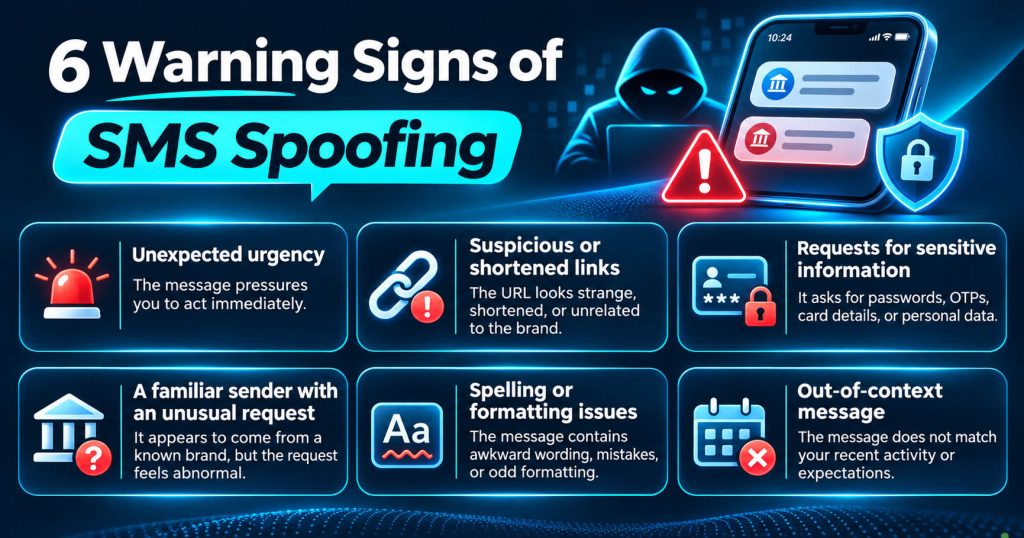
1. Requests for Urgent Action
Messages threaten that an account will be locked, money will be lost, or a penalty will be imposed if no immediate action is taken. This is a common tactic used to create psychological pressure.
2. Suspicious Links
Links may contain domain names that closely resemble real brands, include many unusual characters, or use shortened URLs to hide the destination address. You should not click these links to check them.
3. Requests for OTP Codes or Passwords
Any unexpected message asking you to provide a verification code, password, or PIN should be treated with caution.
4. Payment Notifications from Unclear Sources
You receive a request to pay a delivery fee, a fine, or a charge for a transaction you did not make.
5. Unusual Content
Messages may use unnatural wording, contain inconsistent information, or make requests that do not match normal procedures. However, many scam messages today use very professional language, so you cannot rely solely on spelling mistakes to identify them.
6. Familiar Sender Name but Suspicious Content
This is the most important sign. Even if a message displays the correct bank name or appears in a previous conversation, you still need to verify it through the official application or website. The sender’s name is not absolute proof of a message’s origin.
8 Effective Measures to Prevent SMS Spoofing
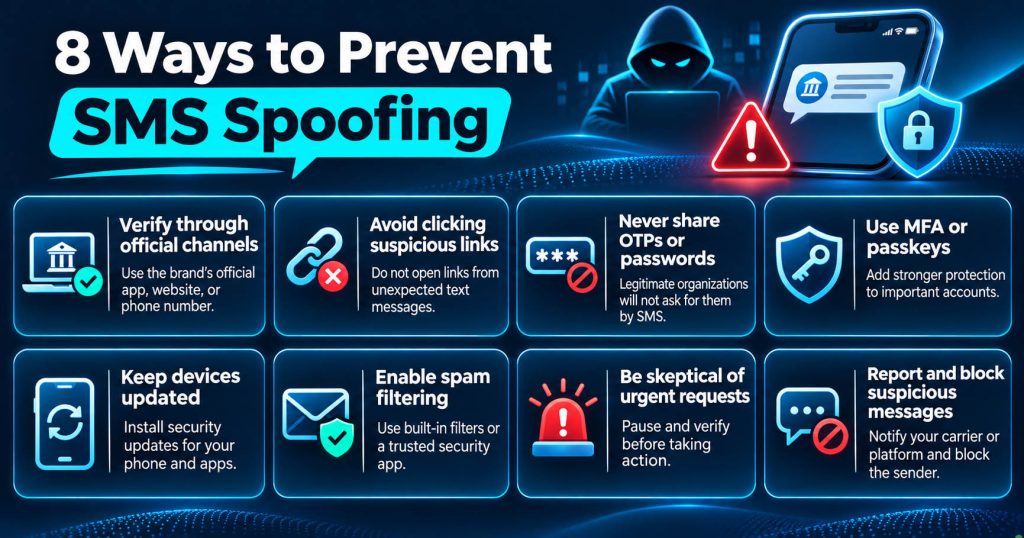
There is no single method that can completely block all spoofed messages. However, combining the following measures can significantly reduce the risk of becoming a victim.
1. Do Not Trust the Sender ID Completely
Do not determine whether an SMS is legitimate based only on the sender’s name or number. If the content involves passwords, financial transactions, or sensitive information, verify it independently.
2. Do Not Click Suspicious Links
When receiving unexpected SMS messages, avoid clicking links that ask you to log in or provide information. Instead, access the official website address directly or open the business’s application.
3. Verify Information Through Official Channels
If a message notifies you that there is a problem with your bank account, check directly through the banking application. If you need to contact support, use the phone number published on the official website rather than calling a number appearing in a suspicious SMS.
4. Do Not Share OTP Codes or Passwords
OTP codes should only be entered into a legitimate verification process that you initiated yourself. Do not forward codes to anyone, even if they claim to be a bank employee or a member of the security department.
5. Enable Spam Message Filtering
Messaging applications on iPhone and Android provide spam filtering or reporting features. Enable the available protection features and update your operating system regularly. Some mobile carriers also support tools for detecting and blocking suspicious messages.
Need a Virtual Number Right Now?
Skip the wait — rent an instant virtual number and start receiving SMS codes in seconds.
6. Use Stronger Authentication Methods
For important accounts, you should prioritize passkeys or phishing-resistant security keys if the service supports them. Authenticator apps also help reduce dependence on SMS OTP, although codes in these apps can still be stolen through phishing attacks.
7. Limit the Public Exposure of Personal Information
Do not share too much personal information on social media or untrusted websites. Limiting publicly available data can make it more difficult for scammers to create targeted fraudulent messages.
8. Report and Block Suspicious Messages
Use the Report Spam feature in your messaging application or report the messages to your mobile carrier. In the United States and the United Kingdom, users can forward suspicious messages to the short code 7726 according to instructions from the relevant authorities. However, reporting procedures vary by country. You should use the official reporting channels in your place of residence.
What Should You Do If You Receive or Fall for a Spoofed SMS?
If you receive a suspicious message, the most important thing is not to rush into following its instructions.
Step 1: Stop Interacting with the Message
Do not click any more links, reply to the message, or call the phone number provided in it.
Step 2: Check with the Actual Organization
Open the official website or application to verify the information. If the organization has no record of the reported incident or corresponding request, the message may be spoofed.
Step 3: Protect Your Account If You Have Provided Information
If you have entered your password on a suspicious website, change it immediately using a trusted device. Check your login history, sign out of unfamiliar sessions, and update your authentication methods. If you have disclosed an OTP, immediately check for unusual activity on the relevant account.
Step 4: Contact Your Bank If There Is a Financial Risk
If you have provided card information or transferred money, contact your bank as soon as possible. Request assistance with protecting your account, checking transactions, and handling payments that show signs of fraud.
Step 5: Check Your Device
If you have installed an application from a suspicious link, check for new applications, access permissions, and your device’s security status. Use a trusted security tool or seek technical support if you suspect that your device has been compromised.
Step 6: Keep Evidence and Report the Incident
Keep screenshots of the message, the time it was received, links, and related transaction information. Then report the incident to your mobile carrier, the impersonated organization, or the relevant authorities.
How Can Businesses Prevent SMS Spoofing?
SMS Spoofing does not only affect individual users. Businesses are also at risk of having their brand names exploited by scammers to defraud customers.
Register and Protect SMS Sender IDs
In markets that support Sender ID registration, businesses should complete the verification process and protect their brand names. For example, Australia is implementing an SMS Sender ID registration system from July 1, 2026, to limit brand impersonation through SMS.
Use Reputable SMS Providers
Businesses should work with providers that have sender verification procedures and comply with regulations on business messaging.
Monitor Reports of Impersonation
There should be a channel for receiving customer reports when suspicious messages appear under the brand name. At the same time, businesses should clearly publish information that they will never ask customers to provide through SMS, such as passwords or OTP codes.
Does SMS Spoofing Affect SMS OTP Security?
Yes. SMS Spoofing can be used as a tool to support attacks aimed at stealing verification codes. For example, scammers may send a spoofed message impersonating the security department and ask users to provide an OTP to confirm unusual activity.
If victims follow these instructions, the OTP code may be exploited to access their accounts. However, SMS Spoofing does not directly redirect OTP codes from a user’s SIM card to an attacker’s device. This is different from SIM Swapping, in which scammers take control of a phone number to receive new messages.
Can Temporary Phone Numbers Prevent SMS Spoofing?
Not directly. A temporary phone number or virtual phone number can help users limit the sharing of their personal numbers in suitable short-term usage situations. However, using a temporary number does not prevent Sender ID spoofing techniques.
In addition, short-term rental numbers are not suitable as the sole recovery method for important accounts. To better understand how to receive and use verification codes, you can refer to the article What Is SMS Verification? on SMS Nova.
Is SMS Spoofing Illegal?
Its legality depends on the purpose of use, the rights to the sender’s identity, and the regulations of each country. A business using a legitimate Sender ID for customer notifications does not constitute fraud.
In contrast, impersonating another organization to steal information, trick people into transferring money, or carry out unauthorized activities may violate the law. Some countries have implemented SMS Sender ID registration or verification mechanisms to limit the risk of spoofing.
Therefore, not every case of customizing an SMS sender name should be considered illegal, but impersonating others for fraudulent purposes poses a serious legal risk.
Advice from SMSNova: Protect Your Privacy and Reduce the Risk of SMS Spoofing
According to the security recommendations of SMS Nova, one of the important principles when using online services is to limit sharing your personal phone number with websites or applications that do not actually need it.
Today, phone numbers are used not only for communication but also for registering accounts, receiving OTP codes, and recovering account access. When a phone number appears on too many platforms, the risk of having information collected, receiving spam messages, or becoming a target of SMS scam campaigns may increase.
However, it is important to understand that using a temporary phone number does not directly prevent SMS Spoofing. Scammers can still spoof the Sender ID regardless of whether users use their personal number or a virtual number. Using a secondary number mainly helps limit how widely your primary phone number is shared and separate online activities.
Why Should You Use a Temporary Phone Number or Virtual Phone Number?
For short-term verification needs permitted by the platform, a temporary phone number or virtual phone number can offer several benefits:
- Protect your personal phone number: Limit the need to provide your primary number across multiple websites and applications.
- Reduce exposure to unwanted messages: Separate your long-term contact number from short-term registration activities.
- Receive SMS online: Access messages and OTP codes through a dashboard without needing to install an additional physical SIM card.
- Flexibly choose a country: Use phone numbers from supported countries, depending on your needs and the service’s compatibility.
- Control costs: Rent a number for each specific need instead of having to maintain an additional long-term mobile subscription.
How Does SMS Nova Help You Manage Verification SMS?
SMS Nova provides temporary phone number and virtual phone number rental services for receiving verification SMS online on supported platforms. Users can choose a country, select the service they need to verify, rent a number, and track messages directly in the SMS Nova dashboard.
This solution is particularly suitable when you only need a phone number for short-term verification purposes, do not want to purchase an additional physical SIM card, or want to limit the use of your personal phone number for non-essential services.
However, SMS Nova recommends that users do not use short-term rented numbers as the sole two-factor authentication or recovery method for bank accounts, primary email accounts, and other important accounts. For these accounts, prioritize strong authentication methods and phone numbers that you can control over the long term.
Important advice: Combine personal phone number protection with the habit of verifying messages through official channels, never sharing OTP codes, and never clicking suspicious links. This is the comprehensive approach to reducing risks from SMS Spoofing and other forms of text message scams.
Explore temporary phone number and virtual phone number services on SMS Nova to receive SMS online more conveniently and limit sharing your personal phone number in suitable situations.
Frequently Asked Questions About SMS Spoofing
1. Can Scammers Send SMS Messages That Display My Phone Number?
Under certain conditions, sender information can be spoofed without taking control of your SIM card. If you discover that your phone number or brand is being misused, contact your mobile carrier for assistance.
2. Does SMS Spoofing Mean That My Phone Has Been Hacked?
Not necessarily. SMS Spoofing involves forging sender information and does not mean that the recipient’s device has been compromised.
3. Can Fake Messages Appear in an Old SMS Conversation?
Yes, they can. Depending on how the messaging application groups conversations and displays sender information, spoofed messages may appear in the same thread as legitimate SMS messages.
4. What Is the Difference Between SMS Spoofing and Smishing?
SMS Spoofing is the act of forging the sender’s identity. Smishing is a form of fraud carried out through SMS. The two techniques can occur simultaneously in an attack.
5. Can SMS Spoofing Steal OTP Codes?
SMS Spoofing does not automatically allow attackers to receive OTP codes sent to the victim’s number. However, it can be used to trick users into voluntarily providing their verification codes.
6. How Can I Tell Whether an SMS Is Spoofed?
Check the message content, links, requests for information, and verify with the organization through official channels. You cannot rely entirely on the sender’s name to determine whether an SMS is genuine.
7. Can SMS Spoofing Be Completely Prevented?
No single solution can guarantee the prevention of every form of spoofing. However, spam filtering, Sender ID registration, source verification, and raising awareness can significantly reduce the risks.
8. What Should I Do If My Phone Number Is Being Spoofed?
Notify your mobile carrier, preserve evidence, and report the incident to the relevant authorities when appropriate. If you use the number for a business, you should warn customers about the spoofed messages that are circulating.
Conclusion: Take Proactive Steps to Protect Yourself Against SMS Spoofing
SMS Spoofing is a technique for forging text message sender information, which can be exploited to steal data, commit financial fraud, and take over online accounts. The danger is that spoofed messages may display familiar brand names, making them difficult for users to recognize based on the phone’s interface alone.
To protect yourself, do not place absolute trust in the Sender ID, do not click suspicious links, do not share OTP codes, and always verify information through official channels. For important accounts, prioritize strong authentication methods and proactively monitor for unusual signs. You can explore more articles about SMS Verification and phone number security on SMS Nova to better understand the risks of using SMS online.
Reference sources:
https://consumer.ftc.gov/consumer-alerts/2025/04/unexpected-text-scam
https://help.twilio.com/articles/12558844999067-Does-Twilio-support-SMS-phone-number-spoofing
https://www.ncsc.gov.uk/guidance/business-communications-sms-and-telephone-best-practice
https://www.ofcom.org.uk/phones-and-broadband/scam-calls-and-messages/how-to-protect-yourself-from-scam-calls-texts-and-messages
https://www.acma.gov.au/articles/2025-10/acma-sets-out-remaining-rules-sms-sender-id-register-participation
Need a Virtual Number Right Now?
Skip the wait — rent an instant virtual number and start receiving SMS codes in seconds.

 Apple
 Telegram