Need a Virtual Number Right Now?
Skip the wait — rent an instant virtual number and start receiving SMS codes in seconds.
Virtual Phone Numbers vs. VoIP Numbers: Key Differences · 1:52
Transcript
Virtual Phone Numbers and VoIP Numbers are increasingly used in online communication, account registration, and receiving SMS verification codes. However, many people still believe that these two types of numbers are exactly the same because both can operate over the Internet without requiring a physical SIM card to be inserted into a phone. In reality, Virtual Phone Number and VoIP Number are two related concepts, but they are not completely synonymous. Some virtual phone numbers may use VoIP technology, while others are provided through traditional mobile number sources. This distinction is particularly important when you need to receive SMS messages, OTP codes, or choose a phone number for business activities. So, what are the key differences in virtual phone number vs voip number? Which type of number is more suitable for account verification? The following article will provide a detailed comparison of the technology, SMS reception capabilities, costs, security, and situations in which each type of number should be used. What Is a Virtual Phone Number? A Virtual Phone Number is a phone number that can be provided, managed, or accessed through an online platform without requiring users to physically insert a SIM card directly into their devices. Instead of using a phone number in the conventional way, users can receive calls or messages through an application, browser, dashboard, or forwarding system provided by the service provider. For example, when renting a temporary phone number to receive an OTP code, you can view the message directly on a website without needing to use a phone with a SIM card. However, this does not mean that virtual phone numbers always operate entirely through VoIP. Depending on the underlying infrastructure, some virtual numbers may be classified as mobile or VoIP numbers.
Virtual Phone Numbers and VoIP Numbers are increasingly used in online communication, account registration, and receiving SMS verification codes. However, many people still believe that these two types of numbers are exactly the same because both can operate over the Internet without requiring a physical SIM card to be inserted into a phone.
In reality, Virtual Phone Number and VoIP Number are two related concepts, but they are not completely synonymous. Some virtual phone numbers may use VoIP technology, while others are provided through traditional mobile number sources. This distinction is particularly important when you need to receive SMS messages, OTP codes, or choose a phone number for business activities.
So, what are the key differences in virtual phone number vs voip number? Which type of number is more suitable for account verification?
The following article will provide a detailed comparison of the technology, SMS reception capabilities, costs, security, and situations in which each type of number should be used.
What Is a Virtual Phone Number?
A Virtual Phone Number is a phone number that can be provided, managed, or accessed through an online platform without requiring users to physically insert a SIM card directly into their devices.
Instead of using a phone number in the conventional way, users can receive calls or messages through an application, browser, dashboard, or forwarding system provided by the service provider.
For example, when renting a temporary phone number to receive an OTP code, you can view the message directly on a website without needing to use a phone with a SIM card. However, this does not mean that virtual phone numbers always operate entirely through VoIP. Depending on the underlying infrastructure, some virtual numbers may be classified as mobile or VoIP numbers.
Common Types of Virtual Phone Numbers
Virtual phone numbers can be distinguished based on their technology and duration of use:
- Virtual VoIP Number: A phone number provided through a VoIP service, typically supporting calls over the Internet.
- Virtual Mobile Number: A number from a mobile service source that users can access or manage remotely.
- Temporary Virtual Number: A number granted for use within a limited period, typically intended for short-term needs.
- Permanent Virtual Number: A number that can be maintained long-term under a contract or the provider’s terms and conditions.
These categories may overlap. A VoIP number can also be rented temporarily or maintained long-term.
To understand more, you can refer to the article What Is a Virtual Phone Number? on SMS Nova.
What Is a VoIP Phone Number?
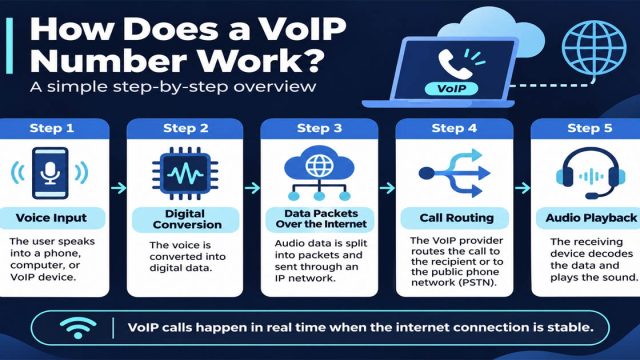
A VoIP Phone Number is a phone number provided through Voice over Internet Protocol (VoIP) technology, which allows users to make and receive calls by transmitting voice data over an IP network.
Instead of depending on a traditional telephone line at the user’s device, VoIP converts audio into digital data and transmits it over the Internet or a suitable IP network. Users can make calls from compatible smartphones, computers, softphones, or IP phones. This technology commonly appears in business phone systems, customer service call centers, and remote communication solutions.
Fixed VoIP and Non-Fixed VoIP
VoIP Numbers are commonly divided into two types:
Fixed VoIP: A VoIP phone number associated with a relatively fixed address, device, or service location.
Non-Fixed VoIP: A VoIP number that is not necessarily tied to a specific physical device and can be provided through an online service.
According to Twilio Line Type Intelligence documentation, Google Voice is an example of a number classified as Non-Fixed VoIP. Both types of numbers can be used for online communication, but SMS reception capabilities and usage limitations depend on the service provider.
Are Virtual Phone Numbers and VoIP Numbers the Same?
Not entirely. A virtual phone number is a broader concept, while VoIP describes the technology or type of voice service being used.
The confusion arises because many VoIP providers also market their products as Virtual Phone Numbers. Both can operate through online applications and do not require users to purchase an additional physical SIM card.
However, they describe different characteristics:
- Virtual Phone Number: Focuses on how a phone number is provided, managed, or accessed.
- VoIP Number: Focuses on the technology and type of telephone service that uses VoIP.
For example, a business may use a VoIP number in a cloud-based phone system to handle customer calls. Meanwhile, an SMS service may provide online access to a number classified as mobile for receiving verification codes. Both may be referred to as virtual phone numbers, but their number types and purposes are not the same.
Can a Virtual Phone Number Be Non-VoIP?
A number classified as mobile by a lookup system can still be provided for users to access remotely through a dashboard. In this case, the number can simultaneously be a Virtual Phone Number and a Non-VoIP Number. Therefore, not physically using a SIM card is not sufficient to conclude that a phone number belongs to the VoIP category.
Virtual Phone Number vs VoIP Number: 8 Key Differences
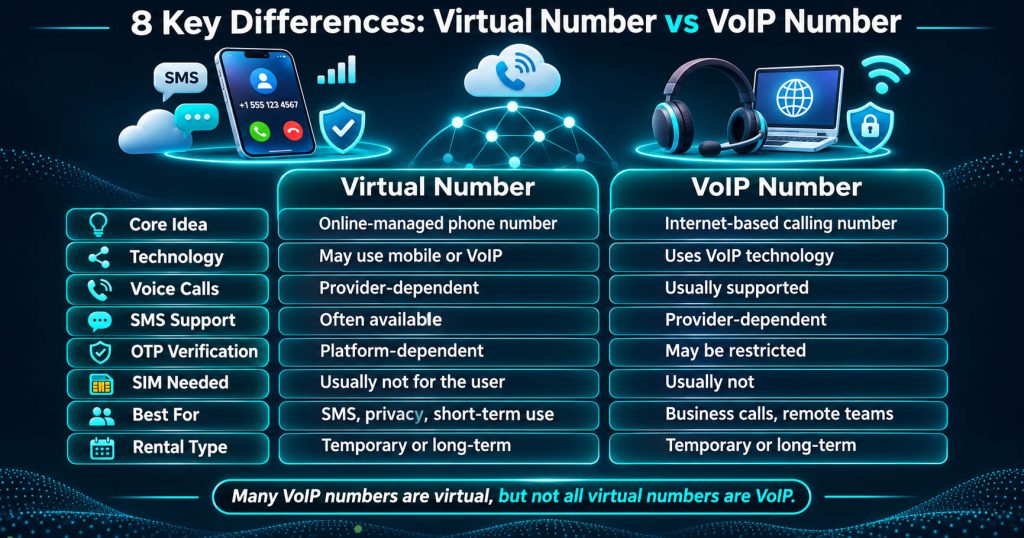
To choose the appropriate type of number, you need to consider the differences in technology, functionality, cost, and usage duration.
1. Technology and Operating Infrastructure
VoIP Numbers use IP telephony technology to transmit and receive calls. Meanwhile, Virtual Phone Numbers can be implemented through various types of infrastructure, including VoIP, call forwarding systems, or mobile number sources. This means that a virtual phone number does not necessarily have to use VoIP for every function.
2. Phone Number Classification
VoIP Numbers are commonly classified as Fixed VoIP or Non-Fixed VoIP. In contrast, virtual phone numbers can belong to different categories depending on their number sources.
For example, two numbers accessed through the same dashboard may have different classification results: one may belong to the mobile category, while the other belongs to the nonFixedVoip category.
3. Calling Capabilities
VoIP Numbers are generally designed to support Internet-based calling needs. Many services support call forwarding, call recording, voicemail, and automated phone systems. Meanwhile, some virtual phone numbers are provided solely for receiving SMS and do not support voice calls. Therefore, you should check the actual features rather than assuming that all virtual numbers can make calls.
4. SMS and OTP Reception Capabilities
This is one of the most important differences. Some VoIP numbers can receive SMS if supported by the provider, but others are designed only for voice calls. Virtual phone numbers using mobile sources may support SMS reception, depending on the service conditions.
However, being able to receive SMS does not mean that the number will be accepted by every platform for OTP verification.
5. SIM Card Requirements
Users of VoIP numbers generally do not need to insert a separate physical SIM card for that number. For Virtual Phone Numbers, whether a SIM card is required depends on the provider’s infrastructure.
Some services use mobile number sources and manage SMS reception through their own systems, allowing customers to view messages over the Internet.
6. Cost Models
Business VoIP services commonly charge subscription fees based on monthly plans, the number of users, or available features.
Meanwhile, virtual phone numbers offer various payment models:
- Monthly subscriptions.
- Number rentals based on usage duration.
- Pay-per-number pricing.
- Fees for short-term verification sessions.
Therefore, you should compare costs based on your intended use rather than relying solely on the name of the number type.
7. Usage Rights and Rental Duration
Both VoIP numbers and virtual phone numbers can be maintained long-term or rented for short periods. The important factors are the contract conditions and control over the number. A temporary number may expire after the rental session and be reassigned by the provider, while long-term business numbers generally have suitable renewal or number transfer mechanisms.
8. Suitable Use Cases
VoIP is generally suitable for calling, phone systems, and business communication. Virtual phone numbers have a broader range of applications, including call forwarding, SMS reception, and short-term account verification. However, the final choice should be based on the number’s actual features and the requirements of the platform being used.
Comparison Table: Virtual Mobile Number vs Virtual VoIP Number
For a more accurate comparison, the following table focuses on two groups of virtual numbers that use different infrastructures.
| Criteria | Virtual Mobile Number | Virtual VoIP Number |
|---|---|---|
| Number type | Mobile | Fixed/Non-Fixed VoIP |
| Online access | Depends on the service | Generally supported |
| User’s physical SIM card | Not necessarily required | Generally not required |
| Voice calls | Depends on the provider | Generally supported |
| SMS reception | Depends on the provider | Depends on the provider |
| OTP reception | Depends on platform policies | May be restricted |
| Common purposes | SMS, short-term verification | Calling, phone systems |
| Rental duration | Short-term or long-term | Short-term or long-term |
| Cost | Based on the number or rental duration | Usually based on service plans |
Virtual Phone Number vs VoIP Number: Which Is Better for Receiving OTPs?
For SMS Verification needs, the most important factors are not whether a number is called Virtual or VoIP, but rather the number type, SMS reception capabilities, and the platform’s verification policies.
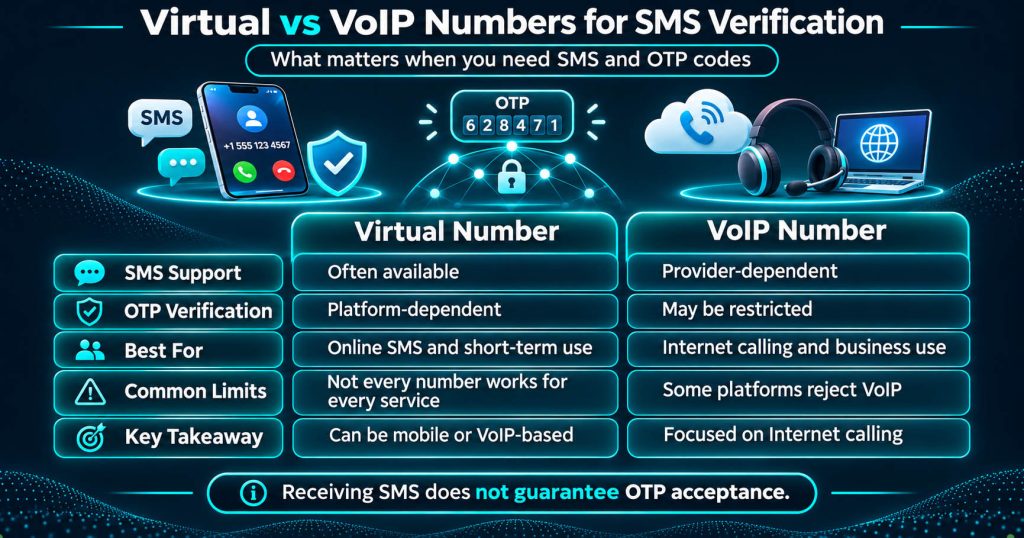
Can Virtual Phone Numbers Receive SMS OTPs?
Yes. Many providers offer virtual phone numbers with SMS reception capabilities through websites or applications. Users can rent a number, enter it into the service requiring verification, and read the OTP code in the dashboard. However, successful SMS reception also depends on the country, number source, mobile carrier, and message delivery route.
Can VoIP Numbers Receive OTPs?
Some VoIP numbers support SMS reception, but not every platform accepts this type of number. For example, a website may require a phone number belonging to a mobile network and reject numbers classified as VoIP. Even if a VoIP number can receive SMS from ordinary users, it may still be unable to receive verification codes from a specific service.
Why Do Some Websites Reject VoIP Numbers?
Some platforms apply risk management policies by checking phone number types before sending OTPs. They may evaluate the country, carrier, number type, and other signals related to usage behavior. This is intended to limit spam, fraud, or activities that do not comply with their policies. However, a rejected number is not necessarily fake or invalid.
Does a Non-VoIP Virtual Number Guarantee Successful Verification?
No.
Even if a number is classified as mobile, the verification process may still fail because:
- The country is not supported.
- The number has been registered before.
- The message is delayed or encounters routing errors.
- The platform limits the number of OTP sending attempts.
- The temporary number does not meet the usage requirements.
Therefore, you should not trust claims that guarantee absolute verification success.
How Can You Check a Number’s Type?
You can use a lookup service such as Twilio Line Type Intelligence. This tool can return number types such as:
| Result | Meaning |
|---|---|
| mobile | Mobile number |
| landline | Landline number |
| fixedVoip | Fixed VoIP number |
| nonFixedVoip | Non-Fixed VoIP number |
| unknown | Number type could not be determined |
Please note that Line Type Intelligence is a paid feature, and classification data may sometimes not be accurately up to date.
Advantages and Limitations of Both Number Types
Advantages of Virtual Phone Numbers
Virtual phone numbers offer flexibility for users who do not want to manage additional physical SIM cards. Users can receive messages online, use secondary numbers, and choose countries based on supported services. With temporary numbers, costs may be calculated per session instead of requiring a long-term subscription.
Need a Virtual Number Right Now?
Skip the wait — rent an instant virtual number and start receiving SMS codes in seconds.
Advantages of VoIP Numbers
VoIP is generally suitable for regular communication needs. Businesses can use numbers across multiple devices, manage calls, and integrate features such as call forwarding or automated phone systems. Some services also help optimize international communication costs.
Limitations to Keep in Mind
Both groups have certain limitations:
- Temporary numbers may expire and be reassigned.
- Not every number supports SMS reception.
- Some platforms restrict VoIP numbers.
- VoIP calls may depend on Internet connection quality.
- Privacy depends on the provider and how the numbers are managed.
Therefore, you should not assume that all virtual numbers offer absolute privacy or that all VoIP numbers are suitable for receiving OTPs.
Should You Choose a Virtual Phone Number or a VoIP Number?
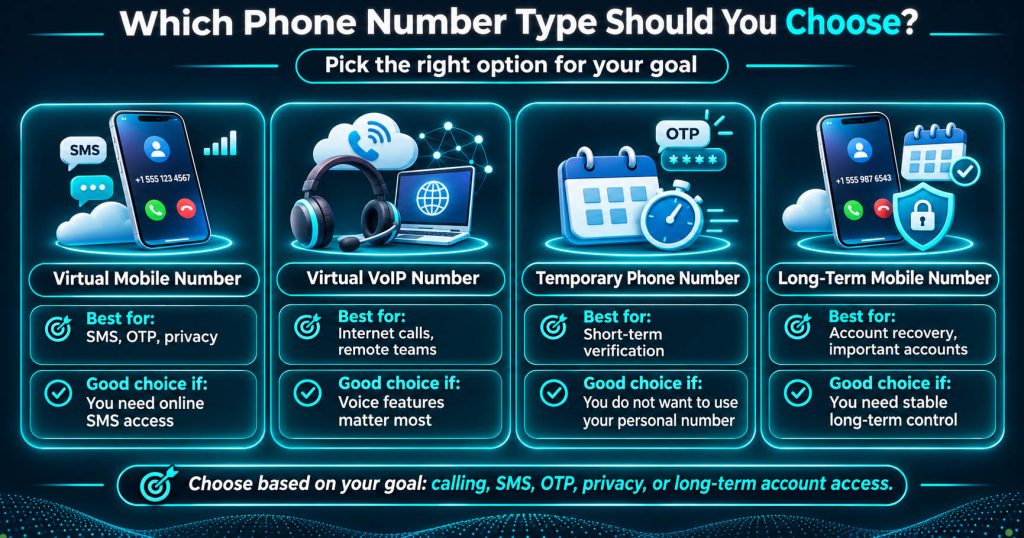
The appropriate choice depends on your intended use.
For business communication: VoIP systems are often worth considering because they offer calling capabilities and call management.
For receiving SMS verification messages: You should prioritize numbers that support SMS reception and meet the platform’s requirements.
For protecting your personal phone number: A secondary or temporary number can help reduce the need to provide your primary number on non-essential websites.
For software testing: Developers should choose services that support the specific calling or SMS features they need to test.
For important accounts: Prioritize a phone number that you can control long-term and stronger authentication methods whenever available.
Quick Selection Table
| Need | Solution to Consider |
|---|---|
| Business calls | VoIP Number |
| Customer service call center | VoIP Phone System |
| Short-term SMS OTP reception | Compatible Temporary Virtual Number |
| SMS testing | A number that supports valid SMS reception |
| Protecting your personal number | A suitable secondary number |
| Long-term account recovery | A mobile number under long-term control |
How to Choose the Right Phone Number
Before renting or registering a number, you should follow these steps.
Step 1: Determine your purpose. Do you need to make calls, receive SMS, verify an account, or maintain a number long-term?
Step 2: Check the number type. Determine whether the number is classified as mobile, VoIP, or another type, if the provider discloses this information.
Step 3: Check the features. Do not assume that a number capable of making calls can also receive SMS.
Step 4: Choose the appropriate country. Check the country code and the requirements of the service you intend to use.
Step 5: Compare prices and rental periods. Review the rental cost, usage duration, and renewal options.
Step 6: Read the privacy and refund policies. This is especially important when renting a temporary number to receive OTPs.
A suitable choice should meet your actual needs rather than simply having a low price or being advertised using attractive terminology.
Is Using a Virtual Phone Number Safer Than Using a VoIP Number?
It is impossible to conclude that one number type is always safer because security depends on the provider, infrastructure, and how the number is used. With public SMS services, messages may be visible to others who access the same inbox.
With services that use a private dashboard, access is generally managed through an account, but users should still review the data storage and protection policies. In addition, some temporary phone numbers may be reassigned after their rental period expires. This creates a risk if the number remains linked to an account that may need to be recovered later. For VoIP, common risks are often related to account security, phishing, or system configuration.
Recommendation: Do not use short-term rented numbers as the sole two-factor authentication or recovery method for bank accounts, primary email accounts, and other important services.
SMS Nova Perspective: Choosing the Right Number Type Matters More Than Its Label
According to SMS Nova user guidance approach, choosing a phone number should be based on its ability to meet your intended needs rather than relying solely on labels such as Virtual, VoIP, or Non-VoIP.
For SMS Verification, three conditions need to be distinguished:
First, the phone number is successfully assigned. This confirms that the user has obtained a number to use during the rental session.
Second, the number can receive SMS. The provider needs to support receiving and displaying messages sent to that number.
Third, the platform accepts the number for verification. This is a separate condition that depends on the policies of the website or application sending the OTP.
These three conditions are not entirely equivalent. Successfully renting a number does not guarantee that an OTP will arrive, and receiving SMS does not guarantee that every verification step on the platform will be completed.
When Should You Use SMS Nova?
If you need to receive SMS messages or OTP codes for a short period on supported platforms, SMS Nova is a solution worth considering. SMS Nova provides temporary phone numbers and virtual phone numbers, allowing users to choose a country and service and monitor incoming messages through a dashboard.
Some of the service’s benefits include:
- Choose numbers from multiple countries and territories.
- Search for numbers based on the service you need to verify.
- Receive SMS online without having to physically install an additional SIM card.
- Check prices before placing a rental order.
- Pay for each number individually, with no mandatory monthly subscription for the standard service.
- A refund mechanism for eligible cases.
According to the SMS Nova pricing page, some options start at $0.01, depending on the country and service.
SMS Nova Recommendations Before Renting a Number
To make a more effective choice, users should:
- Identify the exact platform on which they need to receive an OTP.
- Check the accepted countries and number types.
- Check the availability of numbers.
- Review the price and rental period.
- Read the refund conditions.
- Use numbers only for legitimate purposes that comply with the platform’s policies.
In particular, you should not rent a temporary number solely to try to bypass verification restrictions imposed by a service.
Explore temporary phone number services on SMS Nova to find an option that suits your online SMS reception needs.
Frequently Asked Questions About Virtual Phone Numbers and VoIP Numbers
1. Is a Virtual Phone Number the Same as a VoIP Number?
Not entirely. A virtual phone number describes how a number is provided or accessed, while VoIP refers to voice communication technology over IP. Many VoIP numbers are virtual numbers, but not all virtual numbers belong to the VoIP category.
2. Are All Virtual Phone Numbers VoIP Numbers?
No. Some virtual phone numbers may use mobile number sources and allow users to read SMS messages online. The number type should be determined based on carrier information or lookup services.
3. Can a Virtual Phone Number Be Non-VoIP?
Yes. A number classified as mobile can still be provided through an online system. In this case, the number can be both a Virtual Phone Number and a Non-VoIP Number.
4. Can VoIP Numbers Receive SMS OTPs?
Some VoIP numbers support SMS, but not all numbers have this feature. The ability to receive OTPs also depends on the policies of the platform sending the verification code.
5. Does a Virtual Phone Number Require a Physical SIM Card?
Users generally do not necessarily need to install a physical SIM card in their devices to use a virtual number. However, the provider’s infrastructure may still use mobile number sources or other telecommunications connections.
6. Should You Use VoIP for Two-Factor Authentication?
You should only use it when the platform supports it and you can maintain control of the number. For important accounts, you should prioritize passkeys or suitable authenticator apps when available.
7. Are Virtual Phone Numbers Safer Than VoIP Numbers?
This cannot be generally confirmed. Privacy and security levels depend on the provider, the method of inbox access, the usage period, and account protection measures.
8. Should Businesses Choose a Virtual Number or VoIP?
If you need a call center and call management, VoIP services are generally suitable. If you only need to receive SMS or use a secondary number, you should choose a virtual number service with the corresponding features.
Conclusion: Which Is More Suitable, a Virtual Phone Number or a VoIP Number?
Virtual Phone Numbers and VoIP Numbers are closely related but not exactly the same.
VoIP mainly refers to voice communication technology over IP networks, while virtual phone numbers can be provided through different types of infrastructure and serve various needs. If you need phone calls, a call center, or business communication, VoIP is an option worth considering. If your main purpose is to receive SMS or OTPs, prioritize numbers that can receive messages and are compatible with the verification platform.
For short-term needs, SMS Nova provides temporary phone number rental services, allowing users to receive SMS online without purchasing an additional physical SIM card.
Choosing the right number type, the right service, and the right usage period is more important than focusing solely on the labels Virtual or VoIP.
Reference sources:
https://www.twilio.com/docs/lookup/v2-api/line-type-intelligence
https://www.zoom.com/en/blog/what-is-a-voip-number/
https://www.twilio.com/docs/lookup/quickstart
Need a Virtual Number Right Now?
Skip the wait — rent an instant virtual number and start receiving SMS codes in seconds.

 Apple
 Telegram