Need a Virtual Number Right Now?
Skip the wait — rent an instant virtual number and start receiving SMS codes in seconds.
What Is a Non-VoIP Phone Number? VoIP vs Non-VoIP Explained · 2:01
Transcript
Have you ever registered for an account on a website or app but received the message "VoIP numbers are not supported"? This is a fairly common situation when users use virtual phone numbers to receive SMS verification codes or OTPs. The reason may be related to the type of phone number you are using. While some platforms accept VoIP numbers, others require mobile numbers issued by traditional mobile carriers, commonly referred to as non-VoIP number. So, what is a non-VoIP number? How does it differ from a VoIP number and a virtual phone number? Why is this type of number important during the account verification process? The following article explains how Non-VoIP numbers work, guides you on how to check phone number types, and helps you choose a suitable solution when you need to receive SMS messages online. What Is a Non-VoIP Number? A Non-VoIP Number is a phone number that is not classified as a VoIP (Voice over Internet Protocol) number. This term is commonly used to refer to phone numbers belonging to traditional mobile networks or landline telephone networks, rather than numbers provided by VoIP phone services. In the field of SMS verification, when a website requires a "Non-VoIP Phone Number," it usually means that users must provide a mobile number issued by a mobile carrier and supported for SMS reception. However, it is necessary to distinguish between two types of numbers: Mobile Number: A mobile phone number belonging to a telecommunications network, usually capable of receiving SMS messages and OTPs. Landline Number: A traditional fixed-line phone number that is not VoIP but usually cannot receive SMS messages in the conventional way. Therefore, not all Non-VoIP numbers are suitable for SMS verification. For receiving OTPs, a number classified as mobile is usually a more suitable choice. Examples of Non-VoIP Phone Number Some common examples include: Mobile numbers issued by AT&T, Verizon, or T-Mobile in the United States.
Have you ever registered for an account on a website or app but received the message “VoIP numbers are not supported“? This is a fairly common situation when users use virtual phone numbers to receive SMS verification codes or OTPs.
The reason may be related to the type of phone number you are using. While some platforms accept VoIP numbers, others require mobile numbers issued by traditional mobile carriers, commonly referred to as non-VoIP number.
So, what is a non-VoIP number? How does it differ from a VoIP number and a virtual phone number? Why is this type of number important during the account verification process? The following article explains how Non-VoIP numbers work, guides you on how to check phone number types, and helps you choose a suitable solution when you need to receive SMS messages online.
What Is a Non-VoIP Number?
A Non-VoIP Number is a phone number that is not classified as a VoIP (Voice over Internet Protocol) number. This term is commonly used to refer to phone numbers belonging to traditional mobile networks or landline telephone networks, rather than numbers provided by VoIP phone services.
In the field of SMS verification, when a website requires a “Non-VoIP Phone Number,” it usually means that users must provide a mobile number issued by a mobile carrier and supported for SMS reception.
However, it is necessary to distinguish between two types of numbers:
- Mobile Number: A mobile phone number belonging to a telecommunications network, usually capable of receiving SMS messages and OTPs.
- Landline Number: A traditional fixed-line phone number that is not VoIP but usually cannot receive SMS messages in the conventional way.
Therefore, not all Non-VoIP numbers are suitable for SMS verification. For receiving OTPs, a number classified as mobile is usually a more suitable choice.
Examples of Non-VoIP Phone Number
Some common examples include:
- Mobile numbers issued by AT&T, Verizon, or T-Mobile in the United States.
- Mobile numbers on the Vodafone network in the United Kingdom and supported markets.
- Mobile phone numbers using SIM cards or eSIMs with calling, call reception, and SMS reception capabilities.
- Landline phone numbers classified as landlines.
Note that the carrier’s name or the phone number prefix alone is not enough to accurately determine the number type. To find out whether a specific number is Non-VoIP, you should use a phone number lookup service to check its carrier information.
How Does a Non-VoIP Phone Number Work?
Non-VoIP numbers operate through a carrier’s telecommunications system. For mobile numbers, the carrier manages number allocation, call routing, messages, and connections to subscribers. When a user receives an SMS, the sending system forwards the message to the network or provider serving that phone number.
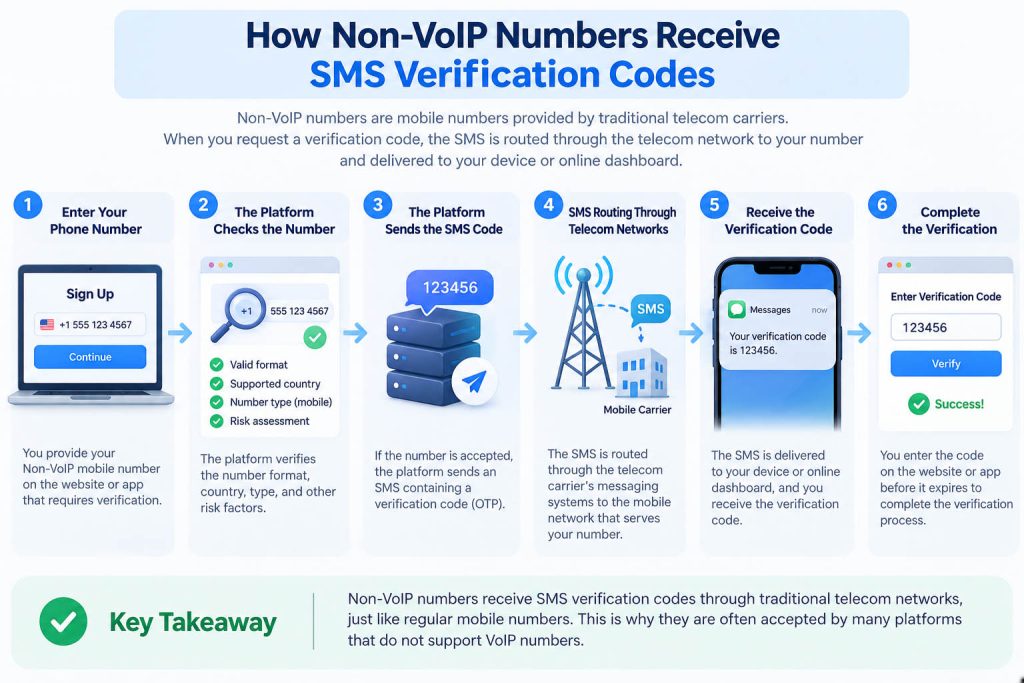
The process of receiving an OTP usually takes place as follows:
- Enter the Phone Number: The user provides a phone number on the website or application that requires verification.
- Check the Number: The platform may validate the format, country, number type, and other risk factors.
- Send the OTP: If the request is accepted, the system sends an SMS containing the verification code.
- Forward the Message: The message is routed through the corresponding messaging systems and telecommunications networks.
- Receive the Verification Code: The user receives the SMS on a device or interface supported by the provider.
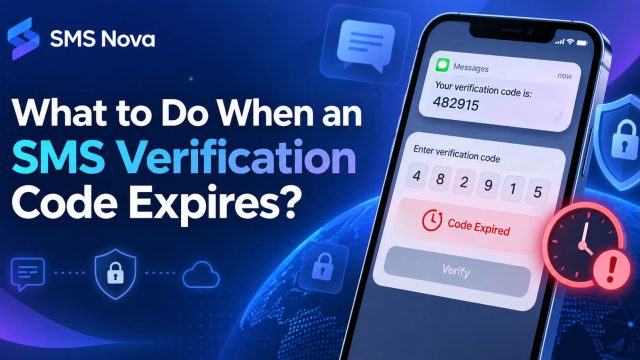
- Complete Verification: The user enters the OTP into the application before the code expires.
It is important to note that Non-VoIP does not mean that the entire infrastructure must operate without using the Internet. Modern mobile networks also use IP technology in many components. The main difference lies in how the number is classified and how the service is provided, rather than simply whether an Internet connection is used.
How Are VoIP and Non-VoIP Different?
To understand Non-VoIP clearly, it is first necessary to know what VoIP is.
What Is a VoIP Phone Number?
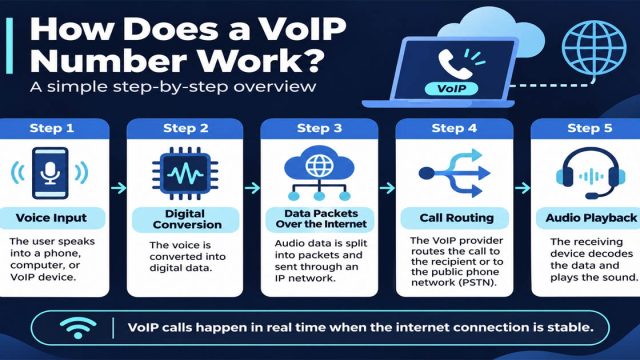
VoIP stands for Voice over Internet Protocol, a technology that allows voice calls to be transmitted over IP networks. VoIP phone numbers are usually provided by Internet phone services. Users can make and receive calls through applications, computers, or specialized devices.
Some VoIP services also support sending and receiving SMS. However, the ability to receive messages does not mean that the number is classified as a traditional mobile number. Google Voice is a common example of a service that can provide a number classified as Non-Fixed VoIP.
Comparison Table: VoIP vs. Non-VoIP
| Criteria | Non-VoIP | VoIP |
|---|---|---|
| Number type | Mobile, Landline | Fixed VoIP, Non-Fixed VoIP |
| Provider | Traditional carriers | VoIP providers |
| Physical SIM | May be used | Usually not required |
| Connection | Telecommunications infrastructure | IP-based services |
| SMS reception | Mobile numbers usually support it | Depends on the provider |
| OTP reception | Depends on platform policies | May be restricted |
| Online use | May be available through an intermediary system | Usually supported directly |
| Cost | Depends on the carrier and plan | Depends on the provider |
The most notable difference for users is not the ability to make calls, but how verification platforms evaluate phone number types.
Some websites only accept numbers classified as mobile. If the system identifies a number as VoIP, the verification request may be rejected before the OTP is sent.
However, this does not mean that all VoIP numbers are blocked. Many services still accept VoIP numbers when they meet the platform’s requirements.
What Are Fixed VoIP and Non-Fixed VoIP?
According to Twilio’s classification system, VoIP numbers can be divided into two main groups.
Fixed VoIP: A VoIP phone number associated with a specific device or service location. This type often appears in business phone systems or fixed telecommunications services.
Non-Fixed VoIP: A VoIP number that can be registered and used online without requiring an association with a specific physical device. Google Voice is an example Twilio uses to illustrate this type of number.
This classification helps platforms determine how to handle phone numbers, but it cannot, by itself, determine whether a number is trustworthy.
Is a Non-VoIP Number a Virtual Phone Number?
This is one of the most common misconceptions when learning about online phone numbers. The answer is: Some virtual phone number can be Non-VoIP, but not all virtual numbers are Non-VoIP. The reason is that the three terms Non-VoIP, Virtual Number, and Temporary Number describe different characteristics.
Non-VoIP Number
Refers to a type of phone number based on line-type or carrier classification information. For example, a number identified as mobile by a lookup system.
Virtual Phone Number
A virtual phone number is a number that can be accessed, managed, or forwarded through an online platform without the user necessarily having to insert a physical SIM directly into their phone. Virtual number can be classified as VoIP or mobile, depending on the source of the number and how the provider implements the service.
Temporary Phone Number
A temp number is a number used for a limited period, usually to meet short-term needs such as receiving SMS, OTPs, or verification messages. The word “temporary” describes the duration of use; it does not determine the technology or number type. For example, a mobile number rented from a provider for 15 minutes that allows the user to receive SMS through a dashboard may simultaneously be:
- A Non-VoIP Number if it is classified as mobile.
- A Virtual Phone Number because it is accessed online.
- A Temporary Phone Number because the usage rights are time-limited.
Therefore, when looking to rent a virtual phone number, you should not assume that all virtual numbers are classified as either VoIP or Non-VoIP.
To learn more, read the guide on how virtual phone numbers work for online verification.
Why Do Some Websites Not Accept VoIP Numbers?
Many online services use phone numbers as part of their account protection processes. Restrictions on certain types of VoIP numbers often stem from risk management policies.
Limiting Spam and Automated Account Registration
Some VoIP services allow numbers to be registered relatively quickly and at a low cost. This may make them vulnerable to misuse for creating accounts in bulk or sending automated verification requests. To limit abuse, some platforms check number types and reject certain number categories.
However, a VoIP number does not necessarily mean a fraudulent number. Many businesses and legitimate users still use VoIP for communication.
Checking Number Types and Carrier Information
Platforms may use lookup services such as Twilio Lookup to identify number types. The returned information may include the carrier and values such as mobile, landline, fixedVoip, or nonFixedVoip. Based on this information, the platform determines whether the phone number meets its verification policies.
Why Can a Non-VoIP Number Still Be Rejected?
A Non-VoIP number does not guarantee 100% successful verification.
Some common reasons include:
- The number has been registered or used before.
- The country or carrier is not supported by the platform.
- The number cannot receive the type of SMS being sent.
- The system detects too many OTP requests.
- The number’s usage period has ended.
- The platform applies additional anti-fraud rules.
Therefore, number type is only one of several factors that affect the verification result.
How to Check Whether a Phone Number Is Non-VoIP
If you want to determine whether a phone number is classified as VoIP or Non-VoIP, you should use a phone number lookup tool instead of relying only on the prefix.
Method 1: Check Using Twilio Lookup
Twilio Lookup provides the Line Type Intelligence feature, which allows users to look up phone number types and carrier information.
To check a number, you can follow these steps:
- Visit the Twilio Lookup documentation.
- Create an account and prepare API credentials if you want to use the service.
- Enter the phone number in the international E.164 format, for example, +1 followed by the subscriber number.
- Make a Lookup request with the line_type_intelligence field.
- Check the type value in the returned result.
Common results include:
| Result | Meaning |
|---|---|
| mobile | Mobile number, usually supports SMS |
| landline | Landline number, usually cannot receive SMS |
| fixedVoip | VoIP number associated with a device or location |
| nonFixedVoip | Non-fixed VoIP number |
| unknown | Number type cannot be determined |
If the result is mobile, the number is classified as a mobile number, not VoIP, according to that lookup system. If the result is nonFixedVoip or fixedVoip, the number belongs to the VoIP category.
Note: Twilio Basic Lookup supports free basic format checks, but Line Type Intelligence is a paid feature. Classification data may also sometimes be inaccurate or out of date.
Method 2: Check the Provider’s Information
Another way is to check information about the number’s source and provider.
Need a Virtual Number Right Now?
Skip the wait — rent an instant virtual number and start receiving SMS codes in seconds.
You can look for information such as:
- Carrier name.
- Type of number provided.
- SMS reception capability.
- Country and area code.
- Terms of use and rental duration.
However, a service advertising a “Real Number” or “Non-VoIP” does not replace the results of a lookup of the specific number type.
Can You Identify a Non-VoIP Number by Its Prefix?
It is not possible to determine this reliably from the prefix alone. For example, two numbers with the same country code, +1, may belong to different number types. Number portability can also cause the current information to differ from the original carrier. For a more accurate assessment, combine lookup data with information from the provider.
Advantages and Limitations of Non-VoIP Numbers
Advantages
Suitable for the mobile number requirements of some platforms
Some websites require a number classified as mobile for registration or verification. Non-VoIP numbers classified as mobile may meet this requirement.
Support SMS and OTP reception
Mobile numbers usually support receiving SMS through carrier infrastructure, provided that the service and message route are compatible.
Offer multiple ways to use them
Users can use a SIM, an eSIM with a phone number, or a service that provides remote access to a mobile number.
Can be maintained long-term
If you own a number from a carrier and maintain the service, you can use the number as a contact method or for account recovery over the long term.
Limitations
Non-VoIP numbers also have limitations that need to be considered.
First, mobile numbers are not guaranteed to be accepted by every website. Each platform has its own verification policies.
Second, owning and maintaining a traditional SIM or eSIM may incur registration, maintenance, or usage fees.
Finally, with a temporarily rented Non-VoIP number, users may lose access after the rental session ends.
Therefore, it is necessary to clearly distinguish between a number being classified as Non-VoIP and having long-term control over the number.
When Should You Use a Non-VoIP Phone Number?
When a Website Requires a Mobile Number for Verification
If a service requires a mobile number and does not support VoIP, you should use a number classified as mobile that you are legally entitled to use. Before getting started, check the supported countries and the platform’s requirements.
When Testing SMS and OTP Systems
For software developers, mobile numbers can be used to test the following processes:
- Sending verification codes.
- Receiving OTPs from carriers.
- Checking message delivery times.
- Handling expired codes.
- Testing the ability to send SMS to multiple countries.
Testing should be performed using numbers that you are legally entitled to use and in accordance with the provider’s policies.
When Long-Term Account Security Is Needed
For primary email accounts, financial accounts, or services containing important information, it is advisable to prioritize a phone number over which you can maintain long-term control. You should not use a short-term rental number as your only account recovery method.
Where Can You Get or Rent a Non-VoIP Number?
Depending on your needs, you can choose one of the following common options.
1. Traditional Mobile Carriers
This is a common way to obtain a phone number classified as mobile. Users register for a SIM and use the number according to the carrier’s policies. This option is suitable when you need to receive SMS regularly or maintain an account over the long term.
2. eSIM Services with Phone Numbers
Some eSIM plans provide mobile numbers that support voice calls and SMS reception. However, not every eSIM has a phone number. Many travel eSIM plans provide Internet data only and do not support receiving OTPs through conventional SMS. Before purchasing, you should clearly check whether the plan includes a mobile number and SMS functionality.
3. Online Phone Number Providers
Some online services provide phone numbers for short-term SMS reception needs. The numbers provided may belong to different types, including mobile or VoIP.
When choosing a service, you should consider:
- Number type and carrier.
- OTP reception capability.
- Supported countries.
- Usage duration.
- Price and refund conditions.
- The ability to continue receiving SMS after renting.
Using Temporary Phone Numbers on SMSNova
If you only need to receive SMS or OTPs for a short period, SMS Nova is an option worth exploring.
SMS Nova provides a temporary phone number rental service that allows users to choose a country, select the service they need to verify, and receive messages through an online interface. Some SMS Nova service pages introduce Non-VoIP number sources. However, you should not assume that every number in the system belongs to this category.
Before renting, you should check the number type information, if available, the price, usage duration, compatibility, and refund policy. SMS Nova is more suitable for short-term SMS reception needs than for maintaining a phone number as a recovery method for important accounts.
Explore Temp Phone Numbers on SMSNova
Frequently Asked Questions About Non-VoIP Numbers
1. Is a Non-VoIP Number a Real Phone Number?
Non-VoIP numbers can be mobile or landline numbers issued within a telecommunications system. However, the concept of a “real number” is not an official technical number category. Even VoIP numbers can be valid phone numbers that are legally assigned.
2. Can a Non-VoIP Number Receive OTP Codes?
Yes, if it is a mobile number that supports SMS, the message delivery route is compatible, and the platform accepts the number. For landline numbers, SMS reception is usually limited or unsupported.
3. Can You Get a Non-VoIP Number for Free?
Some providers may offer free trials or promotions. However, you should not assume that all services offering free numbers provide Non-VoIP numbers. Check the number source, privacy, and usage duration before registering.
4. Is Google Voice Non-VoIP?
According to the classification example in Twilio’s documentation, Google Voice belongs to the Non-Fixed VoIP category. Therefore, you should not assume that Google Voice numbers meet the Non-VoIP requirements of platforms that only accept mobile numbers.
5. Are All Virtual Phone Numbers VoIP?
No. A virtual phone number describes how a number is provided and managed through an online system. Some virtual numbers may be classified as mobile, while others belong to the VoIP category.
6. Can You Use a Non-VoIP Number Without a Physical SIM?
Yes. For example, you can use an eSIM with a mobile number or access a mobile number through an online service provider. Not directly inserting a physical SIM does not automatically make a number VoIP.
7. Does Using a Non-VoIP Number Guarantee Successful OTP Verification?
No. Verification success depends on the number type, carrier, SMS delivery route, country, usage history, and website policies. Some Non-VoIP numbers may still be rejected or fail to receive OTP codes in certain situations.
Conclusion
A Non-VoIP Number is a term for phone numbers that are not classified as VoIP, usually including traditional mobile and landline numbers. In the field of SMS verification, the most important number type is usually mobile, because mobile numbers can receive SMS and may meet the verification requirements of platforms that do not support VoIP.
However, Non-VoIP numbers, virtual phone numbers, and temporary phone numbers are not mutually exclusive concepts. A phone number can belong to all three categories simultaneously, depending on its source and how it is used. Before choosing a number, check its type, SMS reception capability, and usage duration. In particular, do not consider Non-VoIP a guarantee of successful OTP verification.
If you need a phone number to receive SMS for a short period, you can [explore the temporary phone number service at SMS Nova and choose a solution that suits your actual needs.
Reference sources:
https://theduotalk.io/blog/non-voip-number
https://incognum.com/guides/non-voip-numbers/
https://voidmob.com/blog/non-voip-sms-verification-guide
https://en.wikipedia.org/wiki/Mobile_number_portability
Need a Virtual Number Right Now?
Skip the wait — rent an instant virtual number and start receiving SMS codes in seconds.

 Apple
 Telegram