Need a Virtual Number Right Now?
Skip the wait — rent an instant virtual number and start receiving SMS codes in seconds.
What Is a VoIP Number? How It Works and When to Use It · 2:06
Transcript
Do you want to have an additional phone number to communicate with customers but do not want to buy a new SIM card? Do you need to make international calls at a reasonable cost or use the same phone number on multiple devices? A VoIP Number may be a suitable solution. Thanks to Voice over Internet Protocol (VoIP) technology, users can make calls over the Internet instead of relying entirely on traditional telephone lines. This technology is becoming increasingly popular in customer service systems, remote work, and virtual phone number services. However, many people still confuse VoIP numbers, virtual phone numbers, Non-VoIP numbers, and temporary phone numbers. In particular, not every VoIP number can receive SMS or OTP codes from every platform. So, what is a VoIP Number, how does it work, and when should you use one? This article will explain important concepts, analyze the advantages and disadvantages, and help you choose a number type that suits your actual needs. What Is a VoIP Number? A VoIP Number is a phone number that uses Voice over Internet Protocol (VoIP) services, allowing calls to be made and received over an IP network instead of requiring a traditional telephone line at the user's location. VoIP stands for Voice over Internet Protocol, commonly known as Internet telephony technology. Unlike traditional landline phones, a VoIP number can be used on multiple devices, such as smartphones, computers, IP phones, or dedicated calling applications. For example, a business in Vietnam can use a VoIP system to manage customer calls through a computer. Employees working from different locations can still use the same business phone number system if the provider supports it. Is a VoIP Number a Real Phone Number? A VoIP number can be a valid phone number assigned under a telecommunications numbering system and connected to ordinary phone numbers.
Do you want to have an additional phone number to communicate with customers but do not want to buy a new SIM card? Do you need to make international calls at a reasonable cost or use the same phone number on multiple devices? A VoIP Number may be a suitable solution.
Thanks to Voice over Internet Protocol (VoIP) technology, users can make calls over the Internet instead of relying entirely on traditional telephone lines. This technology is becoming increasingly popular in customer service systems, remote work, and virtual phone number services.
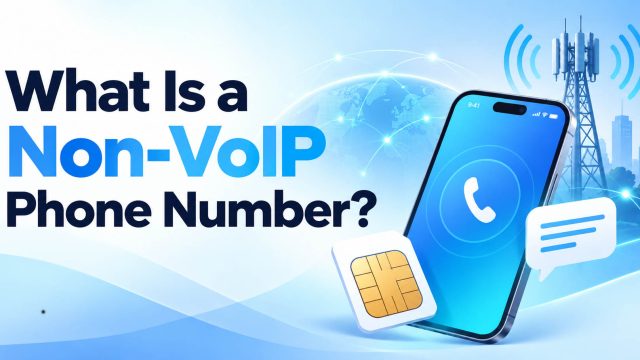
However, many people still confuse VoIP numbers, virtual phone numbers, Non-VoIP numbers, and temporary phone numbers. In particular, not every VoIP number can receive SMS or OTP codes from every platform.
So, what is a VoIP Number, how does it work, and when should you use one? This article will explain important concepts, analyze the advantages and disadvantages, and help you choose a number type that suits your actual needs.
What Is a VoIP Number?
A VoIP Number is a phone number that uses Voice over Internet Protocol (VoIP) services, allowing calls to be made and received over an IP network instead of requiring a traditional telephone line at the user’s location.
VoIP stands for Voice over Internet Protocol, commonly known as Internet telephony technology. Unlike traditional landline phones, a VoIP number can be used on multiple devices, such as smartphones, computers, IP phones, or dedicated calling applications.
For example, a business in Vietnam can use a VoIP system to manage customer calls through a computer. Employees working from different locations can still use the same business phone number system if the provider supports it.
Is a VoIP Number a Real Phone Number?
A VoIP number can be a valid phone number assigned under a telecommunications numbering system and connected to ordinary phone numbers. However, the ability to make calls to mobile networks, send SMS, or receive OTPs depends on the features enabled by the provider.
It is important to understand that a VoIP number is not a fake phone number. The main difference lies in the technology and method of service delivery, not in the validity of the phone number itself.
How Does a VoIP Number Work?
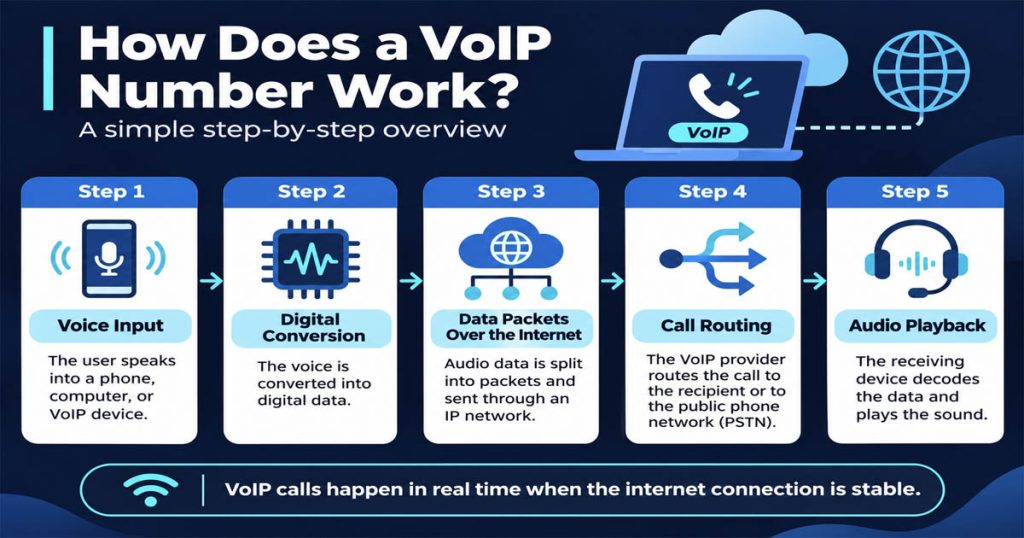
A VoIP Number works by using Voice over Internet Protocol (VoIP) technology to transmit calls over the Internet, rather than relying entirely on traditional telephone lines. When a user makes a call, the VoIP system converts the audio into digital data, divides it into small packets, and transmits them over the IP network to the recipient. At the receiving end, these data packets are processed, decoded, and converted back into audio, allowing the two parties to communicate in near real time.
Does VoIP Require an Internet Connection?
In most cases, devices using VoIP services need to connect to the Internet or a suitable IP network. You can use Wi-Fi, a wired network, or mobile data to connect to the VoIP system.
However, call quality depends on connection stability, network latency, and the provider’s infrastructure. When the Internet experiences problems, calls may be interrupted, lose audio, or fail to connect.
Common Types of VoIP Numbers
Not all VoIP numbers are the same. In the telecommunications field, people commonly distinguish between Fixed VoIP and Non-Fixed VoIP.
Fixed VoIP Number
Fixed VoIP is a type of VoIP number associated with a specific address, device, or service location. This type of number is commonly used in business phone systems, offices, or services that require a registered service address. Some Fixed VoIP providers may support emergency calling based on the registered address. However, emergency calling capabilities still need to be checked with each provider and in each country.
Non-Fixed VoIP Number
Non-Fixed VoIP is a type of VoIP number that, under common classification methods, does not need to be tied to a specific physical device or location. Users can register and use this type of number through an online account or a supported application. According to Twilio Line Type Intelligence documentation, Google Voice is an example of a number that may be classified as nonFixedVoip.
Local, Toll-Free, and International VoIP Numbers
In addition to classification by technology, VoIP numbers can also be categorized by purpose:
- Local VoIP Number: A phone number that uses a local area code.
- Toll-Free Number: A number designed so that callers are not charged for calls within the applicable service coverage.
- International VoIP Number: A number belonging to another country or market, serving international communication needs.
These characteristics are not mutually exclusive. A VoIP number can be both a local number and a Fixed VoIP number.
How Are VoIP and Non-VoIP Different?
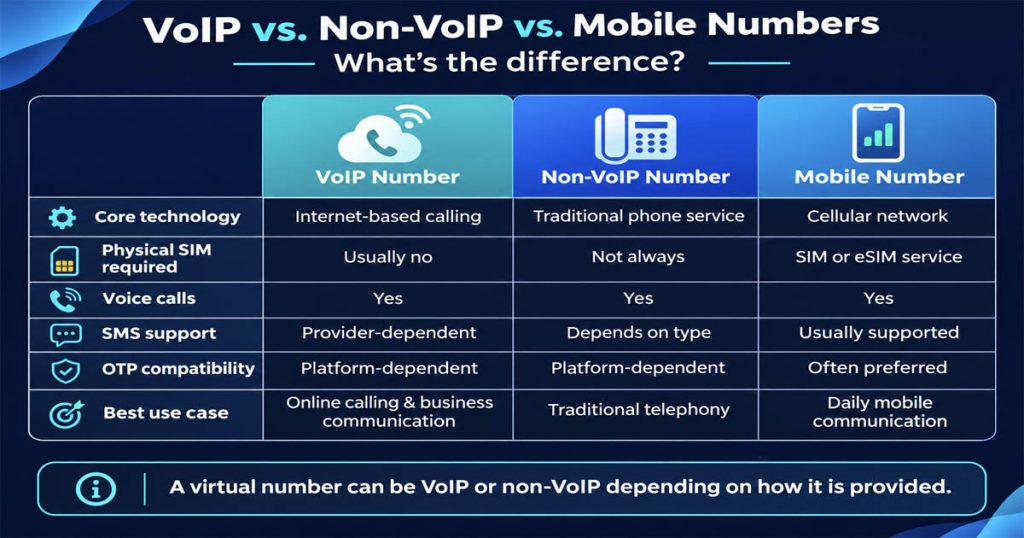
One of the most common questions is the difference between a VoIP Number and a Non-VoIP Number.
VoIP refers to a number belonging to an IP-based voice service. Meanwhile, Non-VoIP is commonly used to refer to numbers that are not classified as VoIP, such as mobile numbers or traditional landline numbers.
For OTP reception, this difference is particularly important because some platforms may check the number type before sending a verification code.
Comparison Table: VoIP, Mobile, and Landline
| Criteria | VoIP Number | Mobile Number | Landline |
|---|---|---|---|
| Main infrastructure | VoIP/IP service | Mobile network | Landline telephone |
| Requires a physical SIM card | Usually no | SIM or eSIM | No |
| Depends on Internet at the device | Usually yes | Not required | Depends on the technology |
| Make calls | Yes, depending on the service | Yes | Yes |
| Receive SMS | Depends on the provider | Usually supported | Usually limited |
| Receive OTPs | Depends on the platform | Depends on the platform | Usually unsuitable |
| Use across multiple devices | Usually supported | Depends on the service | Depends on the system |
| Best suited for | Internet-based communication | Mobile communication | Landline communication |
Is VoIP the Same as a Virtual Phone Number?
The two terms are often used in similar contexts, but they are not exactly the same.
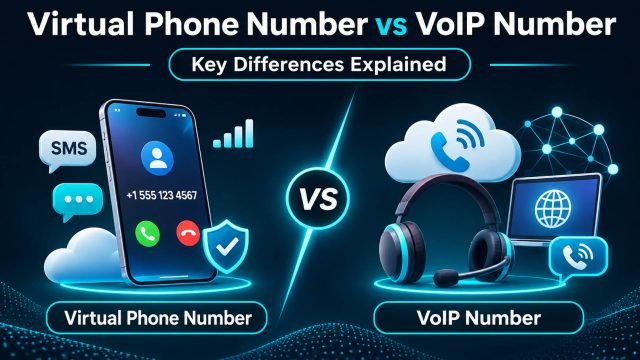
VoIP describes a technology or type of voice service, while a virtual phone number is a broader concept that describes a phone number managed, accessed, or forwarded through a platform without necessarily being directly tied to the user’s physical SIM card.
A virtual phone number may be classified as VoIP or mobile, depending on the provider’s infrastructure. For example, a temporary number rental service may provide a number classified as mobile and allow users to receive SMS through an online dashboard. That number may be virtual in terms of how it is accessed, but it is not necessarily VoIP.
You can learn more in the article What Is a Virtual Phone Number?.
Advantages of Using a VoIP Number
VoIP is increasingly widely used because it offers many benefits for individuals and businesses.
1. Save on Communication Costs
Some VoIP services offer lower rates for international or internal calls compared with traditional telephone solutions. Businesses can also reduce the costs of installing physical phone lines or investing in office PBX equipment. However, actual costs still depend on the service plan, country, and number of calls.
2. Use Across Multiple Devices
Users can access a VoIP system from a phone, laptop, desktop computer, or dedicated IP device. This is especially useful when working remotely or frequently traveling. Some systems also allow multiple devices to ring simultaneously when an incoming call arrives.
3. Separate Personal and Business Communications
VoIP allows users to have an additional contact number for business activities without necessarily making their personal phone number public. Businesses can route incoming calls to specific departments, employees, or customer support teams.
4. Integrate Multiple Advanced Features
Depending on the provider, VoIP may support:
- Call Forwarding.
- Voicemail.
- Call Recording.
- Auto-Attendant.
- Call Routing.
- Customer Relationship Management (CRM) system integration.
These features are suitable for businesses that need to manage a large number of calls.
5. Easy to Scale
As a business grows, adding users or expanding a VoIP communication system is often more flexible than installing additional traditional phone lines. This is a significant advantage for teams working across multiple locations.
Disadvantages and Limitations of VoIP Numbers
Along with its benefits, VoIP still has some limitations.
Dependence on Connection Quality
An unstable Internet connection may cause calls to be delayed, experience choppy audio, or lose connection. For businesses that need their phone systems to operate continuously, preparing a backup connection is worth considering.
Not All VoIP Numbers Can Receive SMS
Some services support voice calls only. Others may provide SMS as an additional feature, but with limitations based on country, number type, or subscription plan. Therefore, before purchasing a VoIP number for account verification, you need to clearly check its ability to receive SMS.
Limitations on Emergency Calls
VoIP services may have specific requirements regarding address registration, emergency call routing, and identifying the user’s location. When power or the Internet connection is lost, some services may also stop working. Users should check emergency calling capabilities according to local regulations and available services, rather than assuming that every VoIP number has functions equivalent to those of a mobile number.
Security Risks
Like many other online services, VoIP accounts can become targets of phishing, password theft, or unauthorized access. Choosing a reliable provider and protecting the account are very important.
Can a VoIP Number Receive SMS and OTP Codes?
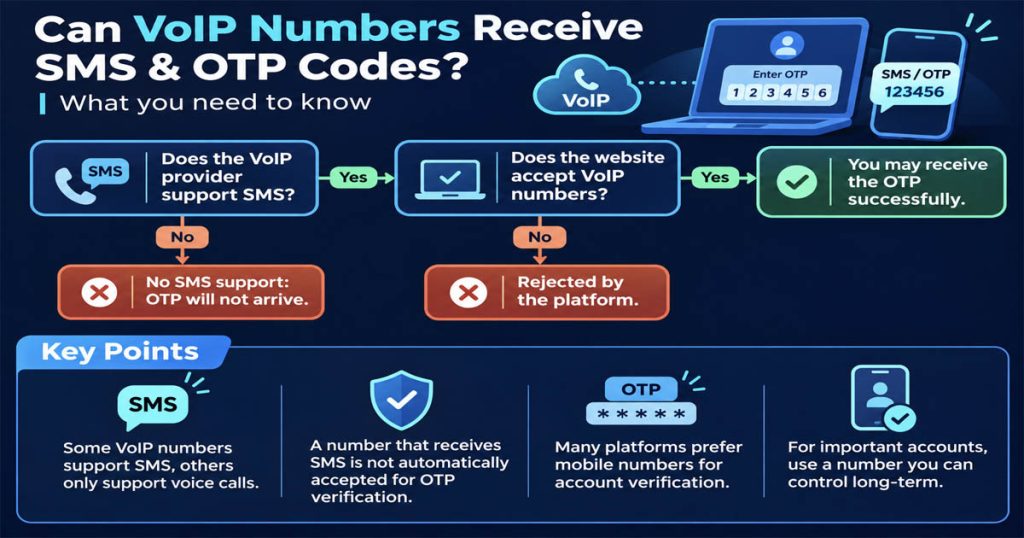
Yes, some VoIP Numbers can receive SMS messages and OTP codes. However, not all VoIP numbers support SMS or are accepted by every website for account verification. This is an issue users need to research carefully before registering for an online phone number.
Why Do Some Websites Reject VoIP Numbers?
Some platforms use phone number type-checking systems to evaluate verification requests.
Need a Virtual Number Right Now?
Skip the wait — rent an instant virtual number and start receiving SMS codes in seconds.
The data may include:
- The country of the phone number.
- The carrier or provider.
- The number type: Mobile, Landline, or VoIP.
- The number’s usage history.
- Other anti-fraud signals.
For example, the Twilio Lookup tool can classify numbers as mobile, landline, fixedVoip, or nonFixedVoip. If a platform requires a mobile number, a VoIP number may be rejected before the OTP is sent. This does not mean that all VoIP numbers are untrustworthy. Acceptance or rejection entirely depends on the service’s policies.
Is VoIP Suitable for Receiving OTPs?
If your primary purpose is to receive OTPs, you need to confirm two conditions:
- Whether the VoIP provider supports SMS reception on the selected number.
- Whether the website requiring verification accepts that phone number.
Even if the number can receive ordinary SMS, the platform may still reject it for account verification. In addition, you should not use a number that you cannot control long-term as the sole recovery method for important accounts.
Are Temporary Phone Numbers and VoIP Numbers the Same?
Not exactly. A temporary phone number is a phone number used for a limited period. The term describes the duration of use, not the number’s technology.
In contrast, a VoIP number is defined by its service or IP-based voice technology. A temporary number may be classified as VoIP or mobile, depending on the provider.
For example, when you rent a phone number to receive a verification code during a short-term session, it is called a temporary phone number because the right to use it is time-limited. However, you need to check the number’s source to determine whether it is VoIP or Non-VoIP.
What Is Temp Mobile for OTP?
The phrase temp mobile for otp is commonly searched by users who need a temporary mobile phone number to receive a one-time verification code.
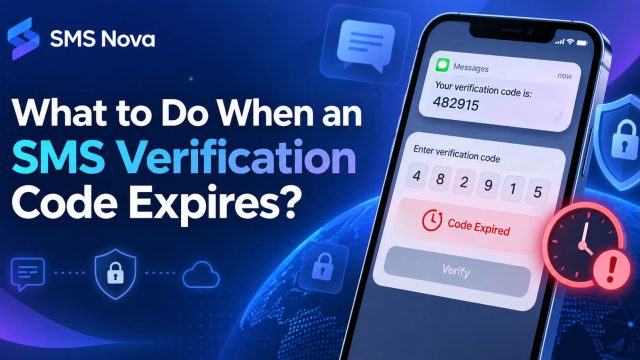
In this case, the user’s goal is not to make calls, but to receive an SMS containing an OTP. Some services, including SMS Nova, provide temporary phone numbers for platforms that support SMS verification.
Users can select a country and service, rent a number, and track SMS messages on the dashboard. However, you should not assume that all temporary phone numbers are mobile or Non-VoIP. The number type needs to be verified when this characteristic is a mandatory requirement.
You can read more in the article How to Rent a Temporary Phone Number on SMS Nova to understand the process of renting a number and receiving OTPs online.
When Should You Use a VoIP Number?
VoIP is suitable for many situations, but it is not always the best solution.
1. Communication and Customer Support
Businesses can use VoIP to create a phone system, receive calls, and route customers to the appropriate department. Features such as call forwarding, call queues, and voicemail help improve operational efficiency.
2. Remote Work
Employees can use a business phone number through a VoIP application on their personal devices or computers. This reduces dependence on a fixed office and helps teams work from multiple locations.
3. Need a Second Phone Number
If you do not want to use your personal number for every work-related call, you can consider a VoIP number as an additional contact number. However, you need to check the number retention period and the provider’s number porting conditions.
4. International Communication
VoIP can be a suitable option when you frequently communicate with customers or partners overseas. Some service plans offer more competitive international calling rates than traditional calling methods.
5. Software Development and Testing
Developers can use VoIP to test voice systems, automated phone systems, call forwarding, or online communication applications. If SMS testing is required, you must use a number type and service that support the appropriate messaging features.
When Should You Not Use VoIP?
You should consider another option when:
- A website requires a Non-VoIP mobile number.
- The service that needs to receive OTPs does not support VoIP number types.
- You need a stable, long-term account recovery method but cannot guarantee that the number will remain available.
- The Internet connection at the place of use is unreliable.
- The VoIP service does not meet your emergency calling requirements.
If your only purpose is to receive short-term verification SMS, a compatible temporary phone number service may be more suitable than a VoIP system designed primarily for calls.
How to Register for and Use a VoIP Number
If you decide to use VoIP, you can follow these basic steps.
Step 1: Choose a VoIP Provider
Find a service that supports your country, features, and communication needs. Consider the price, international calling capabilities, SMS support, stability, and security policies.
Step 2: Choose a Phone Number Type
Depending on the service, you may be able to choose a local number, an international number, or a toll-free number. Check the ability to retain the number and port it to another provider if you want to use it long-term.
Step 3: Set Up an Account
Register, complete any necessary verification requirements, and then install the application or configure a supported device.
Step 4: Test Its Functionality
Make a test call and check the audio quality and ability to receive calls. If SMS is required, test the message-receiving function before using the number for important purposes.
Is Using a VoIP Number Safe?
VoIP can be a secure communication solution if it is properly deployed and managed. However, users still need to be aware of risks such as account takeover, caller ID spoofing, phishing, or unauthorized access to the management system.
To protect your VoIP account, you should:
- Use a strong, unique password.
- Enable multi-factor authentication if the provider supports it.
- Do not share login information.
- Update applications and devices regularly.
- Check for unusual activity in the account history.
- Prioritize providers with clear encryption and security mechanisms.
For businesses, additional measures such as employee access-control policies, signal encryption, and internal network protection can also be considered. It is also important to note that not all VoIP calls are end-to-end encrypted. The level of security depends on the service’s design and configuration.
Frequently Asked Questions About VoIP Numbers
1. Is a VoIP Number a Real Phone Number?
Yes. A VoIP number can be a valid phone number, assigned through a telecommunications system and capable of supporting communication with other phone numbers. The main difference lies in how the service provider operates the service.
2. Can a VoIP Number Be Used Without a SIM Card?
Yes. Many VoIP services allow users to use phone numbers on computers, smartphones, or IP phones without requiring a separate physical SIM card for that VoIP number. However, the device still needs an appropriate network connection.
3. Can a VoIP Number Receive SMS?
Some VoIP numbers support SMS, while others are only used for voice calls. The ability to receive SMS depends on the provider, country, and number type.
4. Can a VoIP Number Be Used to Receive OTP Codes?
It is possible if the number supports SMS and the platform sending the code allows that type of number. However, some websites reject VoIP numbers during account verification.
5. Is Google Voice a VoIP Service?
Yes. Google Voice is a service that uses VoIP technology. In Twilio’s Line Type classification system, Google Voice numbers are commonly used as examples of Non-Fixed VoIP.
6. Are VoIP Numbers Free?
Some services offer free or trial plans, but they may limit calls, SMS, or usage duration. Services designed for businesses generally use a paid pricing model.
7. Can a VoIP Number Be Kept Long-Term?
It is possible if the provider allows it and you continue to meet the requirements for maintaining the number. Keeping or transferring a number also depends on the contract, telecommunications regulations, and service policies.
8. Are VoIP Numbers Safer Than Traditional Phone Numbers?
There is no absolute conclusion. VoIP can provide various security features, but it also introduces risks related to accounts and Internet connections. The level of security depends on how the service is implemented and used.
Conclusion: Should You Use a VoIP Number?
A VoIP Number is a phone number that uses voice services over an IP network, offering many benefits in terms of cost, flexibility, and the ability to manage communications across multiple devices. For individuals and businesses that need to make calls, work remotely, or build customer support systems, VoIP can be a suitable choice.
However, if the main purpose is to receive SMS or OTP codes, compatibility should be checked before use. Not all VoIP numbers support SMS, and not all platforms accept VoIP numbers for verification. If you only need a phone number for a short period, you can explore temporary phone number services, choose a country, and receive SMS online without purchasing an additional physical SIM card.
Explore the Temporary Phone Number service on SMS Nova to find an SMS reception solution that suits your short-term verification needs.
Reference sources:
https://csrc.nist.gov/pubs/sp/800/58/final
https://www.twilio.com/en-us/blog/filter-voip-before-otp-verification
https://www.zoom.com/en/blog/what-is-a-voip-number/
Need a Virtual Number Right Now?
Skip the wait — rent an instant virtual number and start receiving SMS codes in seconds.

 Apple
 Telegram